
< 1910s / 1930s >
c. 1920.
Here’s a note from Annie Swynnerton. She says: “be sure to bring Diana”, and we must remember to call on your Aunt Mary Millais. She is Jack Millais’ daughter you know, and sat in your family pew, as a child, for his popular pictures: My First and Second Sermon.
Diana Holman Hunt (1960) My Grandmothers and I. [A semi-fictionalized autobiographical work.]
1920
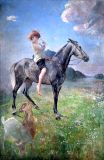
JULY – THE PICTURE OF LADY MERCY GREVILLE. – A contemporary points out that Lady Warwick’s championship and encouragement of her sex in no matter what walk of life, was illustrated by the commission she gave to the woman artist, Annie L. Swynnerton, to paint the portrait of her youngest child, Lady Mercy Greville – a canvas that hangs in this year’s Royal Academy. [Warwick and Warwickshire Advertiser, 17 July 1920, p5.]
OCTOBER – Comment in The Guardian lamenting that Annie is represented in only two public galleries. [In fact, she was represented in five at this date: The Tryst (Salford, acquired 1880), Cupid and Psyche (Oldham, 1892), The Sense of Sight (Liverpool, 1896), Oceanid (Bradford, 1908), Portrait of the Reverend William Gaskell (Manchester, 1914), ]
“I hear that Mrs. Swynnerton‘s painting “A Dream of Italy” has just been acquired by [the] Museum … It is a curious and saddening reflection that this veteran artist … is only represented in two English public galleries. In Manchester [and] Oldham. Mrs. Swynnerton is now in her seventy-sixth year, and if any honour is to come to her from her own country it should not be much longer delayed.“
The Guardian, 19 Oct 1920.
Note: the item names the Metropolitan Museum of New York, but Brooklyn is the correct location, the Met having no record of ever having held or displaying A Dream of Italy.
1922
ELECTION TO THE ROYAL ACADEMY.
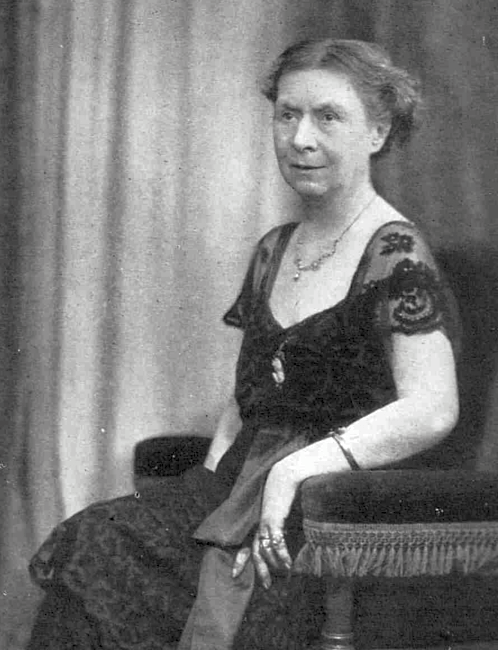
Mrs. Swynnerton Decked Self with Gems To Receive Word of Brief Honor in Art
LONDON – The election of Mrs. Annie L. Swynnerton as an Associate of the Royal Academy in November, an honor subsequently withdrawn owing to the fact that she had passed the age limit for election, caused a great stir. The newspapers reflected this by printing long accounts of how Mrs. Swynnerton learned of her “election” and of her expressed doubts as to its being a fact. Here is the London Daily Graphic’s account, with details regarding her reception of the “news,” her age and her interesting personality:
“The most surprised woman in London yesterday was Mrs. Annie L. Swynnerton, who, at the age of seventy-seven is the first woman elected as an Associate of the Royal Academy since 1768. Three models, young men, rushed to give her the news late on Thursday night. Mrs. Swynnerton apparently did not know, but models make it a rule to wait outside Burlington House during an election of new Associates then they immediately rush off with the news to the artists’ homes, hoping to get a guinea.
“‘I had never seen them before,’ she said. ‘When they knocked at my door, at about eleven o’clock, they made such a noise that I was quite frightened.’
“Mrs. Swynnerton, I am sure, did not accept their news, either believingly or with enthusiasm, because, even yesterday, at lundh-time, when she had read the news in the morning papers, she was inclined to doubt it.
“‘I hope you have not made a mistake,’ she said to a man who called. ‘Perhaps you will find out, later, that I am not an A.R.A. after all.
“‘Artists have sent me telegrams and I have had all sorts of visitors, but I have had nothing official, and really I do not care very much. My first thought is art. If I have been elected, I do not know if it will help women. If they can paint well enough, I suppose they will become members of the Academy. If it’s not in them, they won’t.’
“However, the old lady believed it all sufficiently to dress herself up to receive other visitors who called with congratulations.
“‘Here I am,’ she said, `with all my jewelry on.’ She had put on some old silver rings with red stones in them, and an old silver necklace from which a blue fish was hanging, and looked a real old-fashioned Mid-Victorian, except that she was utterly indifferent to everything except her work.
“Times have changed since she was a girl student. Indeed, she was recalling yesterday the days when women were not even allowed to study in the Royal Academy school.
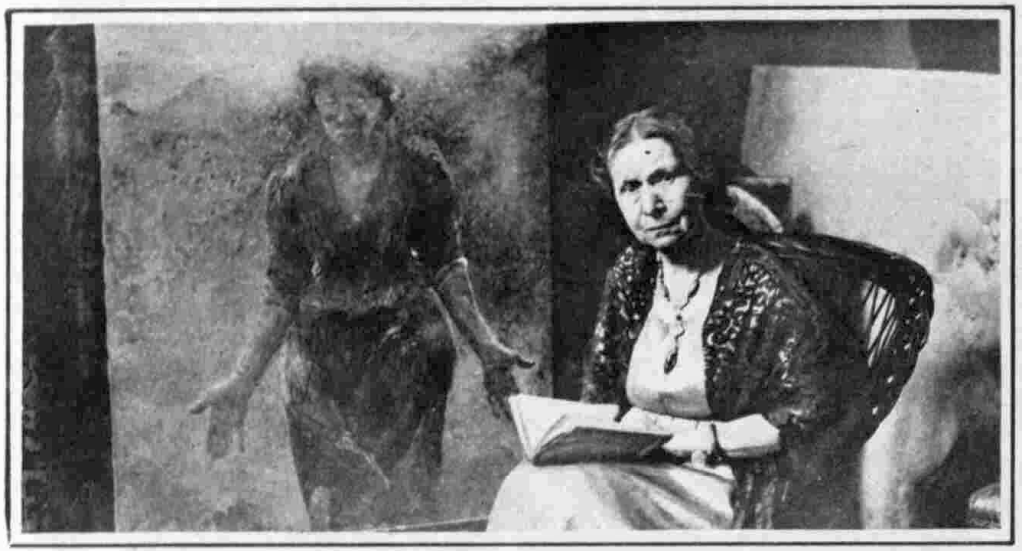
“She consented to be photographed with her latest painting, but she did not want to hold a palette or brush or make any fuss about it. This picture shows an old Italian woman holding her hands out with a background of hills. ‘Southing the Sun,’ I think she calls it. This, she has just finished1. She is now at work on a painting which she has been doing at Newmarket, of two little children on a horse, coming through some foliage. She does all her work out of doors and finishes her pictures there.
“Mrs. Swynnerton is a Manchester woman, a breakaway from her family in talent, like most Manchester intellectuals are. Her father was a solicitor, and none of her relatives was an artist2.”
Another paper expresses the opinion that the purchase of a painting by Mrs. Swynnerton by John S. Sargent, who presented it to the nation, probably had much to do with influencing the Royal Academy to elect Mrs. Swynnerton an Associate. The picture is “The Oreads,” which now hangs in the Tate Gallery. It is a remarkably fine nude study under brilliant lighting.
[Footnotes: (1) The Southing of the Sun is dated on the canvas 1911; (2) at least two of her sisters were recognised artists, as well as her husband Joseph and his brother Frederick.]
American Art News, 23 Dec 1922, p5 (quoting London Daily Graphic).
NOVEMBER

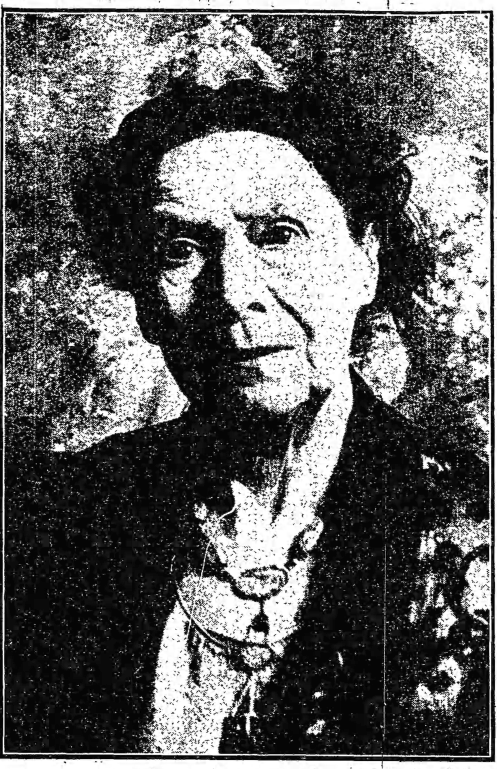
The same photo as above was used in Duluth Herald (Minnesota, U.S.A.), 28 Dec, with the comment, “The Royal Academy, the fountain head of British Art, has just honoured Mrs. Annie L. Swynnerton with election to an associate membership, This is the first time since the days of Sir Joshua Reynolds that a woman has been admitted.“
‘I am much gratified at the honour bestowed upon me,’ she said on learning of her election to the RA, ‘but true art needs no incentive; its work is its own reward.’
Inigo Thomas (27 Sep 2018) London Review of Books, 40(18), pp28-9).
WOMAN A.R.A. … FIRST IN 154 YEARS.
… It is no secret that at least two members of the Academy, Sargent and Mr. Geotge Clausen, have long been her fervent admirers. Mrs. Swynnerton is best known, perhaps, by her portraits of children, often in landscape surroundings, and in several instances on horseback, though she has also painted subjects of a symbolical character, notably a canvas of robust figures in a mountain landscape. called – if memory cau be trusted – “A Dream of Italy.” Vitality is the word that best describes the character of her painting. Even when the drawing is unsteady, the impresition given is less that of incapacity than that the picture is staggering with exuberant life. Mrs. Swynnerton, who is a member of the International Society, was represented in this year’s Academy exhibition by a small, vivid oil painting, ” The Faun.’
Mrs. Swynnerton Interviewed.
“I am naturally delighted by the honour,” Mrs. Swynnerton told a Westminster Gazette reporter who saw her in her South Kensington studio yesterday. “I have painted since I was a girl, and did not take lessons until after twenty, so I think I may claim to be self-taught.
“Am I surprised that I should be the only woman A.R.A. for so long? Well, a little, perhaps. There are women painters who have done very fine work, particularly Mme. Lebrun and Rosa Bonheur. But I do not think, on the whole, that women have done sufficiently good work to warrant their having a grievence against the Royal Academy.” …
Busy Despite Her Years.
Mrs. Swynnerton has had many congratulatory messages. A noted caller yesterday was Mr. Francis Dodd, the artist, who remarked: “I haven’t really come to congratulate you, but the R.A. on their good fortune in having you.”
A native of Manchester, her works have penetrated as far as the Luxembourg, and the Ottowa and Johannesburg collections.
It may be recalled that in 1879 Elizabeth (afterwards Lady) Butler missed election by only one vote, Herkomer defeating her.
Westminster Gazette, 25 Nov 1922, p3.
When Mrs. Swynnerton was elected the news was brought to her hot-foot by three models, who had raced down from Burlington House, each hoping to be the first and to receive the customary tip. She was so surprised and incredulous that one of them promised to return the tip if the news proved untrue. Mrs. Knight* had heard her news from a friend by telephone before three models arrived at her home in St. John’s Wood, but each of them got the expected guinea.
[* Dame Laura Knight (1877-1970), second woman to be elected to the RA in 1936.]
Illustrated London News, 12 Nov 1927 (vol. 171, iss. 4620).
Note in Australian newspaper, including story that she was elected without it being realised she was beyond the normal Academy retirement age.
LADY'S LETTER FROM LONDON. November 30. At last a woman has been elected to the Royal Academy. Mrs. Annie Swynnerton has waited until she was 76* years of age for the honour, but her election will set a precedent which cannot but be followed in the future. Mrs. Laura Knight, for instance, is a woman whose art might well have been honoured in this manner ere now, Mrs. Swynnerton's bold, free style is the reverse of feminine, and her pictures have had an honoured place at academy exhibitions in recent years. I believe there is also a picture from her brush in the Victorian National Gallery. The New York Museum paid a thousand guineas for her "Dream of Italy." Curiously enough, when the members of the Royal Academy elected Mrs. Swynnerton, none of them knew she was over 75 years of age. There is a rule that every associate must retire at 75. Accordingly, Mrs. Swynnerton will immediately retire and become a senior associate. (The Australasian [published in Melbourne, Victoria, Australia] 13 Jan 1923, p49.) [*Error: she was 78.]
DECEMBER
2 December, The Illustrated London News …
9 December, The Sphere …
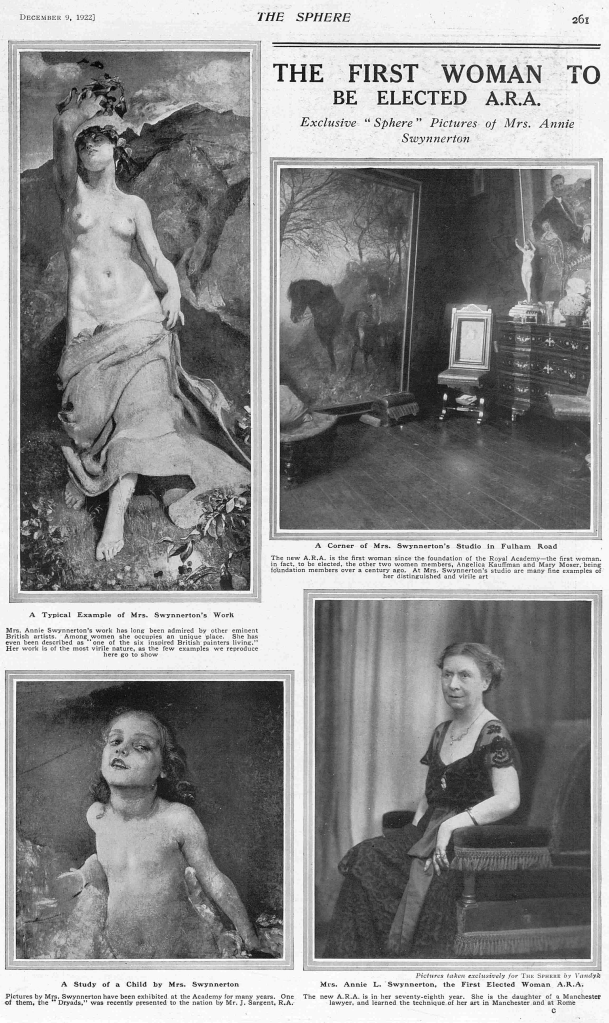
The captions read:
[Top left] “A Typical Example of Mrs. Swynnerton’s Work / Mrs. Annie Swynnerton’s work has long been admired by other eminent British artists. Among women she occupies an unique place. She has even been described as “one of the six inspired British painters living.” Her work is of the most virile nature, as the few examples we reproduce her go to show.“
[Top right] “A Corner of Mrs. Swynnerton’s studio in Fulham Road / The new A.R.A. is the first woman since the foundation of the Royal Academy – the first woman, in fact, to be elected, the other two women members, Angelica Kauffman and Mary Moser, being foundation members over a century ago. At Mrs. Swynnerton’s studio are many fine examples of her distinguished and virile art.“
[Bottom left] “A Study of a Child [New-risen Hope] by Mrs. Swynnerton / Pictures by Mrs. Swynnerton have been exhibited at the Academy for many years. One of them, the “Dryads,” [i.e., The Oreades] was recently presented to the nation by Mr. J. Sargent, R.A.”
[Bottom right] “Pictures taken exclusively for The Sphere by Vandyk* / Mrs. Annie L. Swynnerton, the First Elected Woman A.R.A. / The new A.R.A. is in her seventy-eighth year. She is the daughter of a Manchester lawyer, and learned the technique of her art in Manchester and at Rome.” [*Carl Vandyk, 1851-1931, a German-born, London photographer of royalty and society, as well as being the owner of four hotels.]
19 December, The Victoria Daily Times …
FIRST WOMAN R.A. IS NEARLY EIGHTY
… At a meeting of the Royal Academy recently Mrs Anne [name spelled as in original article] Swynnerton was elected as an associate of the Academy. She is 77.* The election sets a president, because no woman artist has up to now ever been elected, although two women were among the foundation members of the Royal Academy. For years Mrs. Swynnerton has held the leading position among women artists, although others, especially Mrs. Laura Knight, have been more prominantly before the public eye … Mrs. Swynnerton, in an interview, said: “Professionally this recognition of women artists should be a great help. It marks such a very long stage from my young days, when women were not admitted to the Academy schools, and it was difficult for them to get their best work exhibited.
Mr John Sargent is an admirer of her art, and he purchased her picture “Oeads,” [error as in original article, correctly spelled Oreades] which was exhibited at the Royal Academy in 1907.
The work is now in the Tate Gallery.
Mr. George Clausen bought for the National Gallery at Melbourne [Australia] her picture “New-Risen Hope.”
Her work is shown, too, in the New York Museum, the director paying 1,000 guineas [in 1920, equivalent to about £36,000 in 2022] for “A Dream of Italy.”
Mrs. Swynnerton is the daughter of a Manchester lawyer, and was trained at the Manchester Art School. She now works in London.
[* An error. Annie was 78.]
23 December, American Art News …
Mrs. Swynnerton Decked Self with Gems To Receive Word of Brief Honors in Art.
LONDON – The election of Mrs. Annie L. Swynnerton as an Associate of the Royal Academy in November, an honor subsequently withdrawn owing to the fact that she had passed the age limit for election, caused a great stir. The newspapers reflected this by printing long accounts of how Mrs. Swynnerton learned of her “election” and of her expressed doubts as to its being a fact. Here is the London Daily Graphic’s account, with details regarding her reception of the “news,” her age and her interesting personality:
“The most surprised woman in London yesterday was Mrs. Annie L. Swynnerton, who, at the age of seventy-seven* is the first woman elected as an Associate of the Royal Academy since 1768. Three models, young men, rushed to give her the news late on Thursday night. Mrs. Swynnerton apparently did not know, but models make it a rule to wait outside Burlington House during an election of new Associates, then they immediately rush off with the news to the artists’ homes, hoping to get a guinea.
[* An error. Annie was 78.]
“‘I had never seen them before,’ she said. ‘When they knocked at my door, at about eleven o’clock, they made such a noise that I was quite frightened.’
“Mrs. Swynnerton, I am sure, did not accept their news, either believingly or with enthusiasm because, even yesterday at lunch-time, when she had read the news in the morning papers, she was inclined to doubt it.
“‘I hope you have not made a mistake,’ she said to a man who called. ‘Perhaps you will find out, later, that I am not an A.R.A. after all.
“‘Artists have sent me telegrams and I have had all sorts of visitors, but I have “had nothing official, and really I do not care very much. My first thought is art. If I have been elected, I do not know if it will help women. If they can paint well enough, I suppose they will become members of the Academy. If it’s not in them, they won’t.’
“However, the old lady believed it all sufficiently to dress herself up to receive other visitors who called with congratulations.
“‘Here I am,’ she said, ‘with all my jewelry on.’ She had put on some old silver rings with red stones in them, and an old silver necklace from which a blue fish was hanging, and looked a real old fashioned Mid-Victorian, except that she was utterly indifferent to everything except her work.
“Times have changed since she was a girl student. Indeed, she was recalling yesterday the days when women were not even allowed to study in the Royal Academy school.
“She consented to be photographed with her latest painting, but she did not want to hold a palette or brush or make any fuss about it. This picture shows an old Italian woman holding her hands out with a background of hills. ‘Southing the Sun,’ I think she calls it. This, she has just finished. She is now at work on a painting which she has been doing at Newmarket, of two little children on a horse, coming through some foliage. She does all her work out of doors and finishes her pictures there.
“Mrs. Swynnerton is a Manchester woman, a breakaway from her family in talent, like most Manchester intellectuals are. Her father was a solicitor, and none of her relatives was an artist.” Another paper expresses the opinion that the purchase of a painting by Mrs. Swynnerton by John S. Sargent, who presented it to the nation, probably had much to do with influencing the Royal Academy to elect Mrs. Swynnerton an Associate. The picture is “The Oreads,” which now hangs in the Tate Gallery. It is a remarkably fine nude study under brillient lighting.
1923
OUR GREATEST WOMAN ARTIST
The story of Mrs. Swynnerton, who was recently elected to be an Associate of the Royal Academy, by A. B. Cooper. [Pearson’s Magazine, March 1923, pp194-200 (extracts). Many thanks to E_ M_ for forwarding the article.]
… I think I am right in stating that between 1907 … and 1922, when “The Faun” found a place, none of the idealistic [i.e., non-portrait] work of Mrs. Swynnerton has been seen on the walls of the Royal Academy, and from 1914 to 1920 she does not appear in the catalogues at all! [The Oreades was exhibited in 1907, thereafter only portraits, up to the Portrait of David and Jonathan Fenwick in 1914, after which no works listed until the Equestrian Portrait of Lady Mercy Greville in 1920 and two more portraits the following year.]
“I grew tired of sending my work and having it rejected,” she said to me on more than one occasion. “My failure to find acceptance was not only disheartening, but it kept me poor. I was at the Private View on one occasion. Even the picture which had been accepted was badly hung and I was not feeling happy about it. A famous R.A. came to me and praised my work. “‘And yet you have rejected it again and again!’ I said. “Oh, Mrs Swynnerton,’ he replied light-heartedly, ‘work such as yours is independent of the Academy.’ “I looked at him – affable, distinguised, prosperous, popular – and I said: “No, no, Mr. ___, that is not so. It never can be so. Neglect has cramped me, repressed me, depressed me – and kept me poor that I have hardly dared to begin, much less continue through long months and years, the work my heart was set upon.’ And now,” [Mrs Swynnerton] added wistfully, “the Academy has crowned me, and – it is almost too late.”
But to some extent Mrs. Swynnerton has been the martyr of her greatest merit. She has never been able to point to half a dozen canvases in various degrees of artistic completeness and say: “That’s the batch I’m going to show next spring.”
For instance, in her studio, as I write, is an almost finished picture … yet I am not at all sure that it will glorify the walls of Burlington House next May. “I cannot possibly finish it until the lilac buds show again in March,” she said. That remark of a very reticent woman is typical of her whole attitude to her art. “I feel sometimes … as if the best thing that could happen to my pictures would be to have the great joy of painting them in the open air, and then – to burn them!” [Annie describes at some length her appreciation of the different lights and atmospheres of each month, and how she would sometimes take years on a painting, only working on it during a specific time of year.]
“My picture ‘St. Martin’s Summer,’ now in the Liverpool Gallery, was painted in several succeeding Novembers. It belongs in that month … and I must wait till March to finish my lilac picture. I have had pictures wait for years because I have missed the moment. There is a subtle harmony between form and surroundings. The moment you want sometimes passes and may not return … Once, at Capri, I sat on a rock in mid-stream every day for three weeks to get the motion of water in the sunlight – and even then I fear I failed.'”
… She thinks her greatest art is a compramise between painting and sculpture, to attain the sculpturesque.
Mrs Swynnerton is a passionate lover of poetry … she often finds inspiration in the poets … and often the title of a picture … She is justly famous as a painter of the nude, yet she paints draperies as few of her contemporaries can. It is possible that posterity may value her pictures more for their backgrounds than for their main subject, for she is a landscape painter of the first rank, while as a painter of children and ponies she has no superior among living artists.
“… next to [the joy of painting outdoors] has been my joy in the beautiful and lovely people I have known, the appreciation of the foremost men of my time. Burne-Jones was the great and steady friend of my life, and Watts gave me wonderful advice. For my advantages in earlier life were nil, as were my opportunities. I started late and had not these [people] come to my aid, I should have been artistically ‘lost.'”
May 10th: “The annual meeting of the Medical Women’s Foundation … was held at the Trocadero Restaurant, London … The official guests included … Mrs. Swynnerton, A.R.A. …” (https://archive.org/details/britishmedicaljo11923brit/page/870/mode/2up?q=Swynnerton&view=theater).
SPECIAL EXHIBITION OF PAINTINGS BY MRS. SWYNNERTON, A.R.A., 7 JULY to 11 AUGUST, MANCHESTER ART GALLERY.
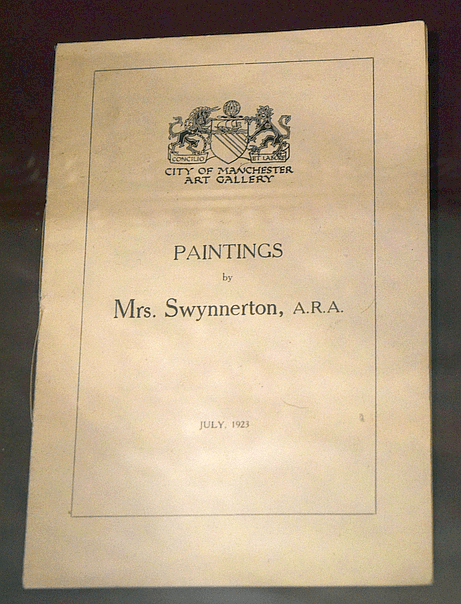
Annie was granted a special solo exhibition at Manchester Art Gallery in honour of her election to the Royal Academy.
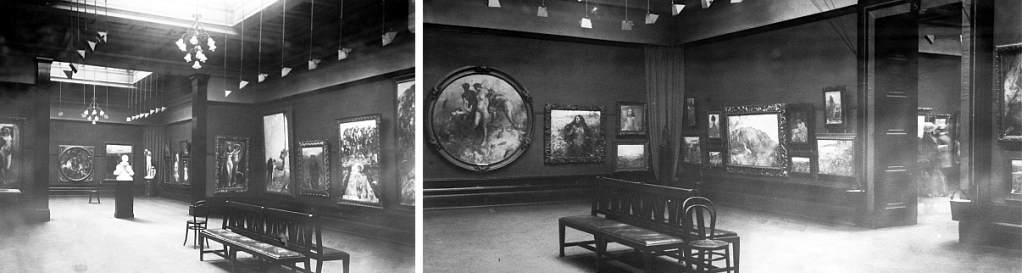
The Lord Mayor … in declaring the exhibition of her pictures open, said it was somewhat a reflection upon Manchester that he work had not been adequately represented here …
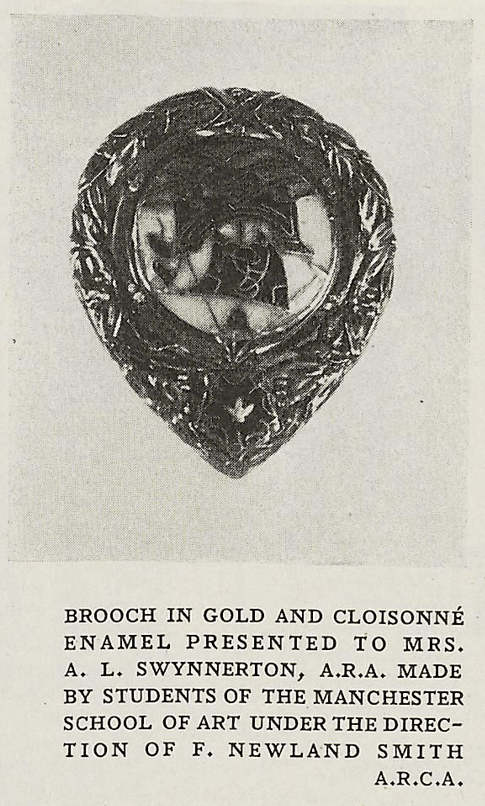
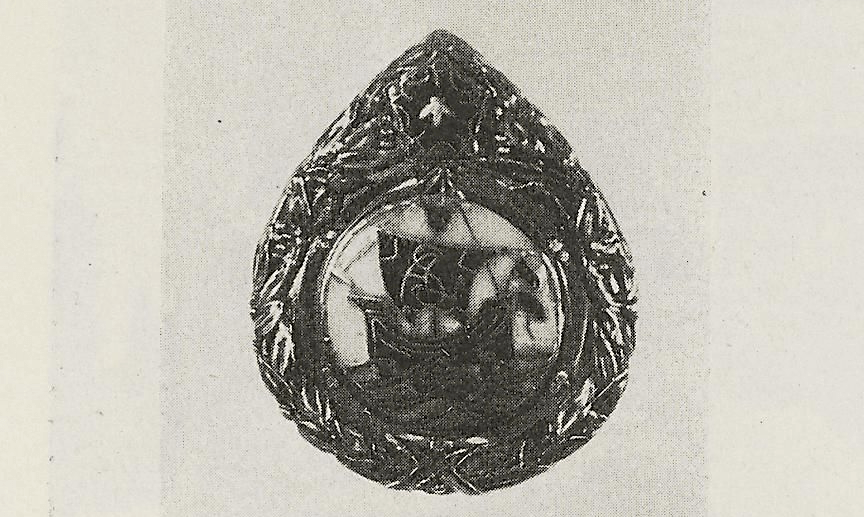
Mr. T. D. Barlow, on behalf of the Royal Manchester Institution, presented to Mrs. Swynnerton a brooch which had been made by the School of Art, a piece of co-operative craftsmanship in gold, silver, and enamel, in the design of which appeared the Manchester city arms, the initials “A.L.S.,” and the badge of the Lancashire rose.
Mrs. Swynnerton [said she] was glad to find so much of her husband’s work here, and so great an honour to him was a deep satisfaction to her.
The Guardian, 7 Jul 1923.
“In addition to Mrs. Swynnerton’s paintings there will also be shown a few examples of Mr. Swynnerton’s statuary” (The Guardian, 30 June 1923).
OCTOBER – Annie exhibited in New York alongside other ‘foreign women artists’ – “A private view of the thirty-third annual exhibition of the National Association of Women Painters and Sculptors was given Tuesday Afternoon at the Fine Arts Galleries, 215 West Fifty-seventh Street … A feature of this year’s exhibition will be the group of paintings and other work by foreign women artists who were invited to take part in it … Valentine Reyre, Madeleine Gregoire and Marie Laurencin from France, Olga Boznanka from Poland, Emma Ciardi from Italy. Also the Brooklyn Museum has lent for the exhibition the painting, “A Dream of Italy,” by Annie Swynnerton …” (Hartford Courant, 21 Oct 1923).
1924
APRIL – THE ATTIC CLUB, MANCHESTER. SOCIETY OF WOMEN ARTISTS.- EXHIBITION of PICTURES, SCULPTURE, & CRAFTWORK, at the College of Technology, Whitworth St.,Tues., April 2, to Sat., April 12, 11 a.m. to 8.30 p.m. Admission Free. (The Guardian, 2 Apr 1924.)
The Attic Club was active in Manchester in the 1920s and 1930s.
DAME LAURA KNIGHT’S comments on Annie in her autobiography Oil Paint and Grease Paint is the, published February 1936 (part 1 of 2):
(Chapter 35) MRS. SWYNNERTON was … then about eighty years old [i.e., c. 1924]; her small body contained the vitality of youth, her black eyes looked you through and through; cross-grained [=stubborn/cantankerous], she bore a perpetual grudge against men, who, she considered, had always been against her. When she started her career it was not thought possible that a woman’s painting could ever be equal to that of a man. Her work had proved that women can have great imagination and power of execution. When one considers the struggle she must have had to reach mastery so tardily recognised, her bitterness is not to be wondered at …
She could scarcely see then, though her eyes were still so bright. I remember exactly what she once told me. “I was painting a big portrait out of doors in Rome; I stood in the sunlight though everyone warned me not to do so, but I wanted my model in the shadow and it was the only thing to do – I had a heat stroke – it affected my eyes – they were wonderful before that!” … [Continued in year 1929.]
1925
MARCH – Isabel noted to be the president of ‘The Attic Club.’
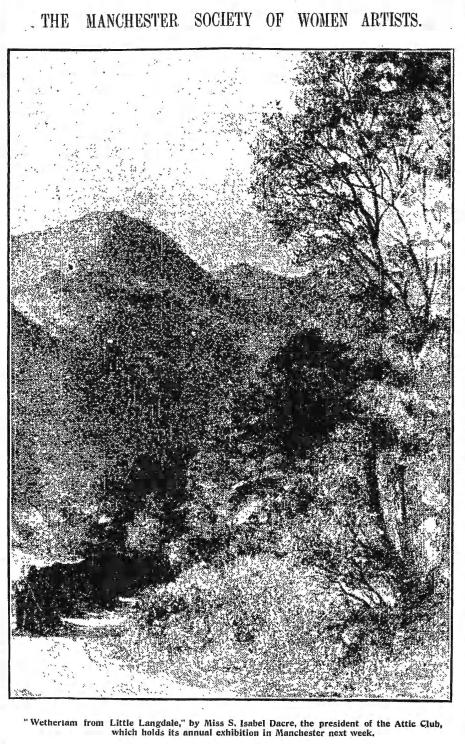
“Wetherlam from Little Langdale,” by Miss S. Isabel Dacre, the President of the Attic Club, which holds its annual exhibition in Manchester next Week.
The Guardian, 21 Mar 1925.
APRIL – Siegfried Sasoon meets Annie at Hill House, 11 April.
… There were a dozen of us at dinner, at two tables, in an exquisite room – gilt and painted Venetian walls and ceiling superimposed on the original Elizabethan structure. The party included Cyril Scott (the composer) and his wife, and Mrs Annie Swynnerton (the aged A.R.A.). After a dinner of salmon and asparagus and turkey and souffle and champagne and port and brandy and a fine cigar (and conversation which made me feel an intellectual colossus) we adjourned to the noble galleried hall and listened to the piano-playing of Cyril Scott … [on the 12th of April] I became quite friendly with poor purblind [partially blind] Mrs Swynnerton, mainly by telling her that Hamo Thornycroft [a famous sculpture] is my uncle. She spoke bitterly against Sickert’s work, but I pleased her by saying that my mother has often spoke admiringly about ‘The Sense of Sight‘ (Mrs Swynnerton’s best known picture) … she really is almost blind.
Rupert Hart-Davis, ed. (1985) Siegfried Sassoon Diaries 1923-1925. London: Faber and Faber.
1926
From: Dickens and Daughter [1], by Gladys Storey (first published 1939):
Mrs. Swynnerton was extremely patriotic. After introducing her to Mrs. Randall (later Lady) Davidson at a private view at the Academy, that lady … mentioned that the Archbishop [2] was sitting for his portrait; Mrs. Swynnerton inquired who the artist was.
“Mr. de Lázló,” [3] replied our hostess.
“But he is a traitor!” vehemently declared Mrs. Swynnerton; “he was interned during the war. Why did not the Archbishop choose an English artist to paint his portrait?”
The incident would have occurred in 1926 or shortly before, as the portrait is dated 1926.
- [1] Charles Dicken’s daughter, Catherine ‘Kate’ Perugini, was a friend of Annie.
- [2] Randall Thomas Davidson, 1st Baron of Lambeth, Archbishop of Canterbury 1903-28.
- [3] Philip de Lázló (1869-1937), Hungarian-born portrait artist who settled in London in 1907.
1927
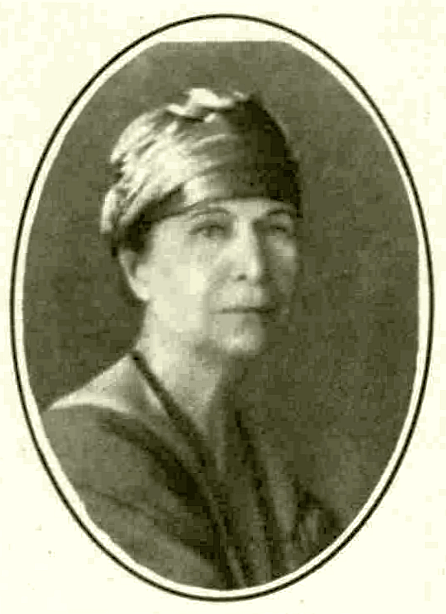
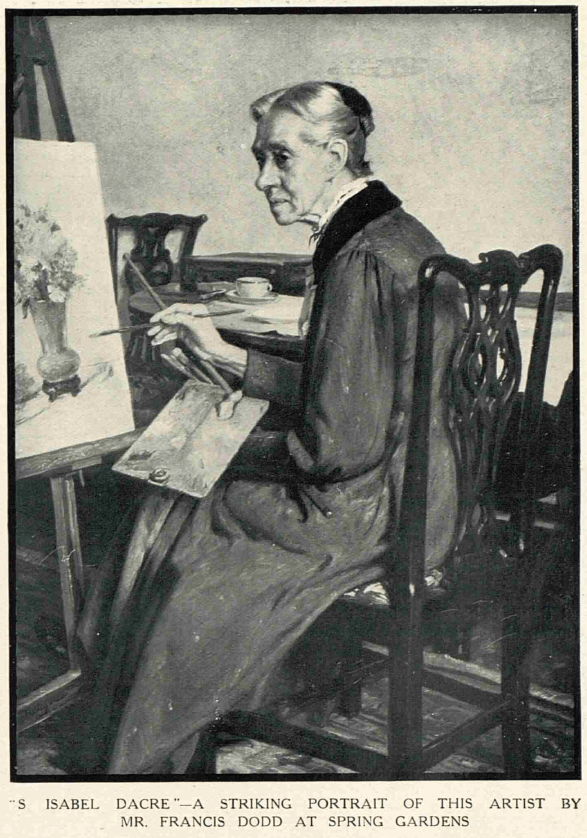
JUNE – Isabel‘s Italian Women in Church is presented to Manchester Art Gallery with a special ceremony honouring Isabel (now aged 83), but mentioning she couldn’t attend the event because of ‘fatigue’ …
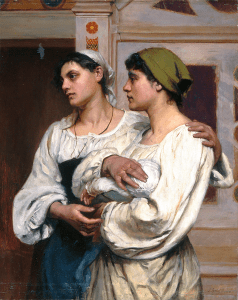
“MISS ISABEL DACRE. A notable tribute to the artist … A fitting tribute to the esteem in which Miss Isabel Dacre is held in art quarters has been paid by the purchase by a group of admirers of her picture “Italian Women in Church” and its presentation to the permanent collection of the Manchester Art Gallery. An address … has been delivered to Miss Dacre by Mr. Nicholls, president of the Manchester Academy of Fine Art; a course which was adopted owing to the artists’s inability to bear the fatigue of a ceremonial presentation … arrangements are being made to hold a special an representative exhibition of Miss Dacre‘s works in the autumn … The address, presented to Miss Dacre reads:- … a testimony to your genius … [signed by] Mr. Francis Dodd … Mr Allan Monkhouse … the Attic Club … Miss Fanny Sugars … Miss F. M. Monkhouse … Miss Mary McN. Wroe … Mrs. Annie L. Swynnerton … [seventy-five other names].” (The Guardian, 18 Jun 1927.)
In the autumn of 1927, an exhibition of [Isabel‘s] work – along with that of two other artists – was hel in the Gallery, and gave Manchester people the the opportunity to appreciate her as a painter of landscapes. One of her Umbian landscapes is now hanging in the annual exhibition of the Manchester Academy … her Italian landscapes, which she began to produce in 1899, have a grave, serene, and intimate beauty not readily appraised by casual sketchers and tourists.(The Guardian, 21 Feb 1933.)
DECEMBER
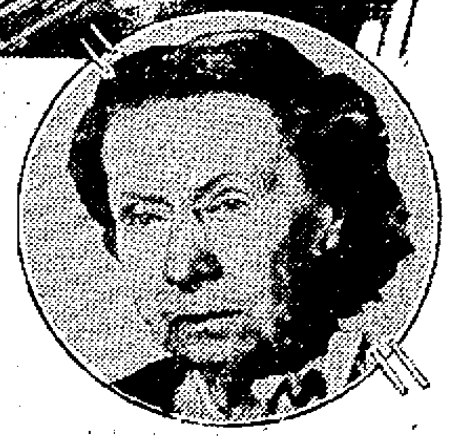
Photograph from an article (mainly on Laura Knight) in The Evening Independent newspaper, Massilon, Ohio, 13 Dec 1927. “… Mrs. Annie L. Swynnerton, now 82 years old … Mrs. Swynnerton still takes an active interest in the world of art and has a country studio. She began painting as a child and studied for a career. She is a member of the International Society of Sculptors, Painters and Gravers. The best known of her pictures are “The Sense of Touch,” [error as in original article, should read … The Sense of Sight] in the Liverpool Gallery, and “St. Martin’s Summer.” She was represented in this year’s Academy showing by a landscape, “The Gulf of Spezia.”
1928
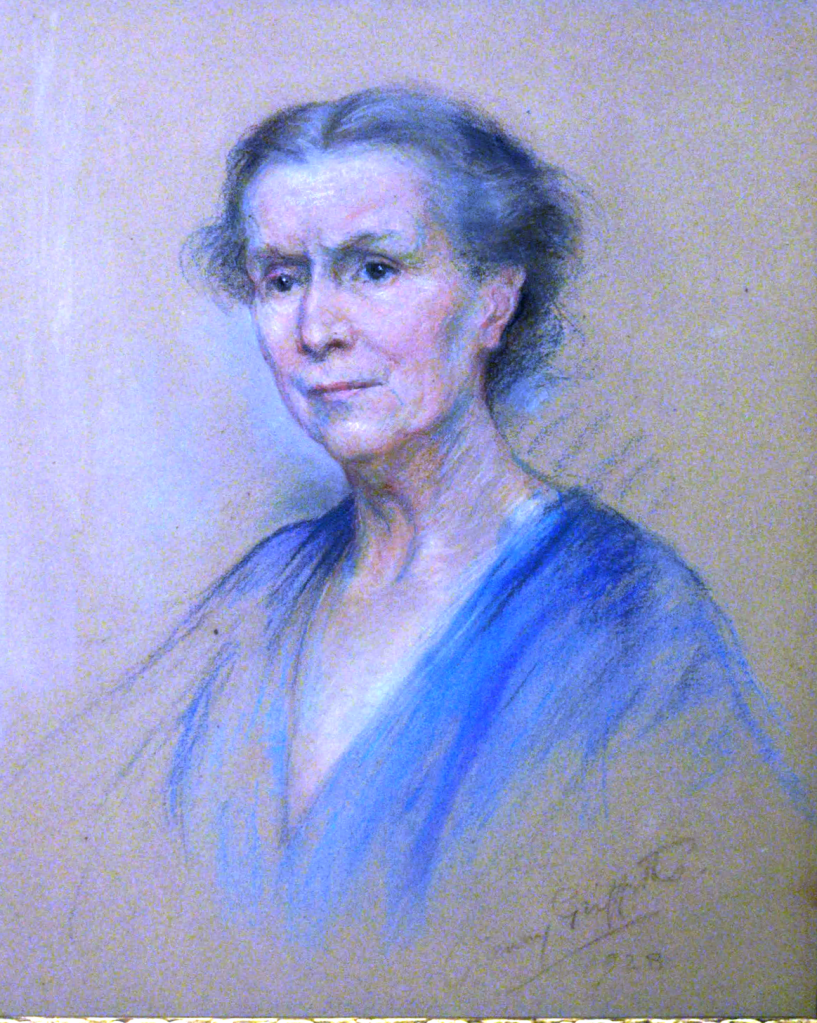
Portrait of Annie L. Swynnerton by Gwenny Griffiths. (Manchester Art Gallery.)
13 Oct 1928 - "the opening of the Autumn Exhibition at Brighton on Saturday afternoon … the opening was performed by Mrs. Annie L. Swynnerton, A.R.A. … who has contributed three pictures to the exhibition." Eastboure Gazette, 17 Oct 1928, p3.
The Brighton exhibition was one which aspired to be extra special and of national importance, including works by Pissaro (La Montagne de Siciém le Brusque), Laura Knight (Madonna of the Cotton Fields) and Annie (West Sussex Gazette, 18 Oct 1928, p11).
Motor car accident.
While crossing a road in Chelsea – not seeing an oncoming motor car – she was knocked down and taken to St. Luke’s Hospital, where it was found her leg was broken in two places. She quite enjoyed herself lying in a ward and being visited by friends, who brought her flowers and dainties to eat. After some weeks she came out into the world again – not much the worse for her accident – using a walking-stick.
Gladys Storey (1971) Dickens and Daughter. New York: Haskell House. First published 1939. p200.
“WOMAN ARTIST HURT. Mrs. Annie L. Swynnerton, Associate of the Royal Academy, was crossing Fulham-road when she was knocked down by a motorcar. She was removed to hospital where it was found she was suffering from an injured foot. She was reported on Tuesday [6 Nov] afternoon to be progressing comfortably” (Western Mail, 7 Nov 1928, p9). “… badly injured in her foot” (Daily News (London), 7 Nov 1928, p9).
“Mrs. Annie L. Swynnerton, A.R.A., whose foot was injured in a motor car accident, is progressing favourably at St. Luke’s Hospital, Chelsea.” (Yorkshire Post and Leeds Intelligencer, 7 Nov 1928, p10.)
1929
First Woman A.R.A. MRS SWYNNERTON was the first woman elected to the Academy since the far-off days of Angelica Kauffmann. Sargent was a great admirer of her work and his influence has much to do with her election in 1922. Mrs. Swynnerton has pictures by Sargent in her studio, and over the mantelpiece is the cormorant, with outstretched wings, which used to be in that great painter’s studio.
LONDON DAILY CHRONICLE, 13 April 1929. (John Singer Sargent (1856-1929) died two days after this article was published.)
Mrs Annie L. Swynnerton, A.R.A., has been working hard for the last two months to get her pictures finished in time for this year’s Academy exhibition. Last November was knocked down by a motor, and the accident prevented her completing the two large pictures on which she was engaged … Mrs Swynnerton has pictures by Sargent in her studio, and over the mantlepiece is the cormorant with outstretched wings which used to be in that great painter’s studio. (Dundee Courier, 16 Apr 1929, p12.)
Annie is photographed by Emil Otto Hoppé (1878-1972), a leading portrait, travel and documentary photographer of the early twentieth century.
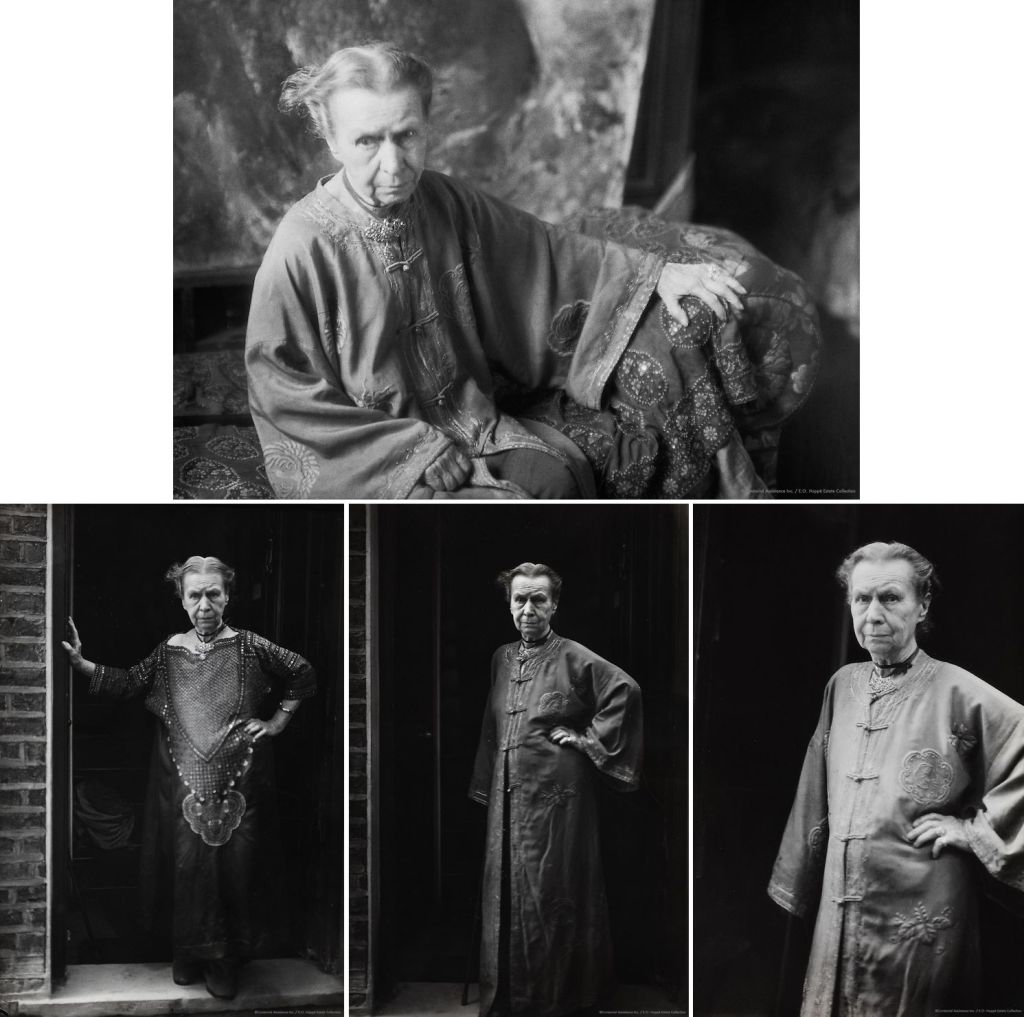
DAME LAURA KNIGHT’S comments on Annie in her autobiography Oil Paint and Grease Paint, published February 1936 (part 2 of 2, first part in year 1924):
[In 1929, after being made a Dame at the Palace, at] the next Members Varnishing Day, I sat next to Mrs. Swynnerton. She offered congratulations. With the utmost sincerity I assured her that, instead of myself, I wished that she had been the recipient of the decoration. “Did they give it to you as the first woman to be elected to the Academy?” she asked. “No, certainly not,” I replied. Then in a gracious way she said, “I am glad it has been given to you; no one deserves it better.”
We spent a wonderful hour and I came closer to her that ever before. A brave little figure in her purple Indian blouse. Coupled with the joy in my new distinction was a fear that the honour I had received was but adding to her bitterness.
[Annie’s] studio was visited by a lady who considered herself a connoisseur on art. “I can only admire Botticelli,” she remarked and, looking through her lorgnette* at a picture hanging above the mantelpiece, she inquired: “Your work?” “Mine?” cried Mrs. Swynnerton indignantly, “that, madam, is a Botticelli!”.
The Queen, 17 Apr 1929, date of incident not stated. (* lorgnette = pair of spectacle lenses mounted on a handheld stick.)
< 1910s / 1930s >
Page last updated 1 Sep 2025.
 ANNIE LOUISA SWYNNERTON and SUSAN ISABEL DACRE (1844-1933)