
This website showcases the works of the artists Annie Louisa Swynnerton and Susan Isabel Dacre, with additional notes on others in their artistic circles.
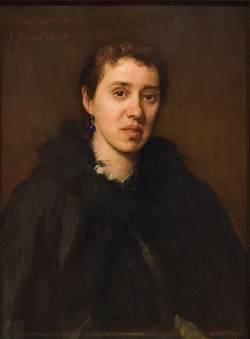
CLICK HERE FOR ANNIE LOUISA SWYNNERTON’S WORKS
CLICK HERE FOR SUSAN ISABEL DACRE’S WORKS
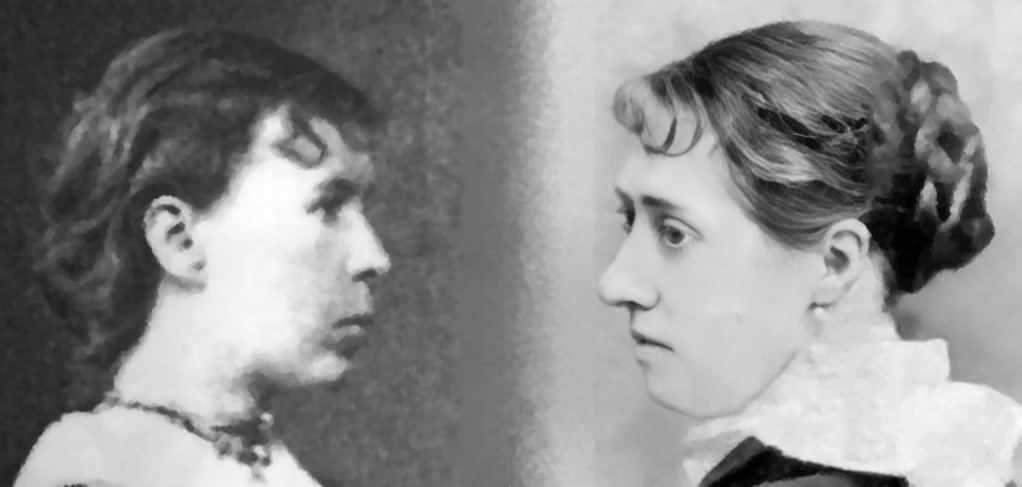
Of the two, Annie Louisa Swynnerton (left above, born 26 Feb 1844) is seen as the most sigificant, being the first woman to be elected to the Royal Academy of Arts and for her sometimes challenging ‘symbolist’ works. Susan Isabel Dacre (born 17 Feb 1844) – who went by her middle name in life – is near-forgotton these days, but, in the earlier part of their careers, was the most prominant and considered an artist of extraordinary ability. For more on Isabel and her works, click HERE.
Having met at Manchester School of Art, both graduating in 1873, Annie and Isabel travelled and studied on the continent. Once home they founded the Manchester Society of Women Painters (1879) as a way of getting round restrictions placed on their practice by the male-dominated art scene of the era. They were also friends with and committed supporters of the Pankhursts and other Manchester-based campaigners for women’s votes (although never involved in any militant ‘suffragette’ activity).
Annie and Isabel were born at a time when access to professional training, gallery representation and membership of art institutions was generally denied to women. They were also disadvantaged by not having easy access to the financial support necessary and were expected to paint a restricted range of subjects, such as flora, portraits or domestic scenes.
“… women had to create specific training opportunities for themselves, find artists associations which allowed them to increase their public visibility, and fight for their acceptance in a male-dominated institutionalized exhibition scene.” (Nike Seidl (2020) DoME.)
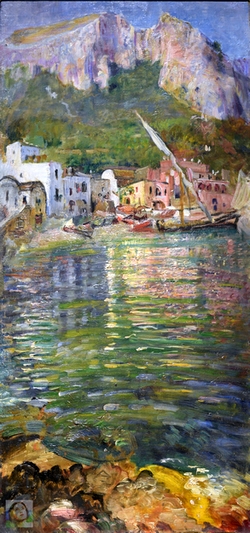
Annie’s ability and creativity challenged the conventions of the time. Not only was her work technically equal to that of her male contemporaries, but she depicted women as independent, assertive and confident individuals, at a time when they were typically portrayed in a passive or stereotyped manner. Isabel’s art consisted of conventional portraits and landscapes, but with a level of skill which was quite outstanding.
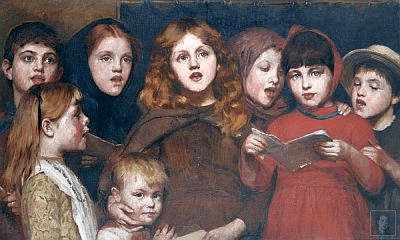
In 1883 Annie married the Manx born, Rome-trained sculptor Joseph Swynnerton and they settled in the artistic community in that city. Joseph sadly died aged only 62 in 1910, after which Annie returned to England. Isabel never married, moving to London in her later years and ceased exhibiting at the Royal Academy after 1894, apart from a single work in 1929. Annie, however, had multiple works accepted by the Academy from the early 1900s onwards.
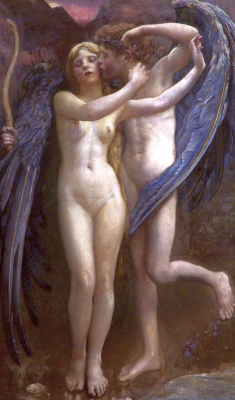
While Annie’s technical skill was praised, British galleries consistently rejected her works for inclusion in their permanent collections. She was, however, being accepted into national collections in the United States, Canada, Ireland, France, South Africa and Australia, and at times was exhibited alongside some of the most avant-garde artists of the time – the post-Impressionists and their successors – although her own work maintained a firmly ‘representational‘ style.
Annie finally achieved official recognition in Britain in 1922, when, at the age of 78, she became the first woman to be admitted to the Royal Academy of Arts, following much lobbying by famous artists such as John Singer Sargent, Edward Burne-Jones, John Everett Millais and George Frederic Watts, all friends of hers. Angelica Kauffman and Mary Moser had been founding members of the Academy in 1768, but were never fully involved in the daily affairs of the institution or elected as such – Annie was the first woman admitted on equal terms to men. She was initially classed a full member, but when it was realised she was beyond the normal cut-off age for admission, 75, she was given the title ‘Senior Associate’ instead and listed above all other ‘Associates’ in exhibition catalogues.
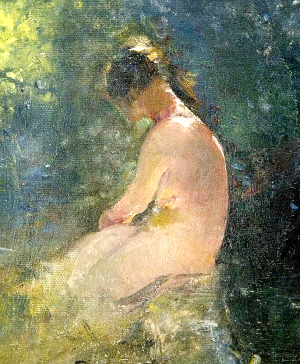
Isabel died 20 Feb 1933 and Annie on 24 Oct the same year. Having only a small number of paintings in public galleries, along with the continuing tendency of institutions and academics to ignore female artists into the early twentieth century, recognition of Annie’s and Isabel’s achievements rapidly diminished.
Annie is known to have produced many paintings in her lifetime. Hundreds of works were found in her studios in London and Rome after her death. Most of these quickly disappeared, sometimes being sold as bundles of lots at auction.
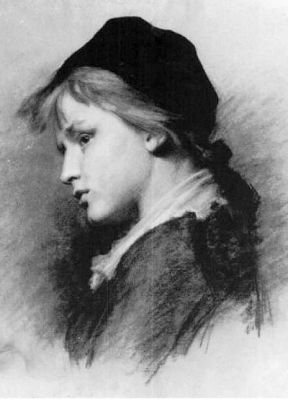
The one sizeable public collection of Annie’s and Isabel’s paintings today is at Manchester Art Gallery – sixteen and seventeen works respectively – largely thanks to generous bequests made in the 1920s and ’30s. There are twenty-one works by Annie in other British galleries and six overseas. For Isabel there are six works in British galleries outside Manchester and a single drawing (the chalk portrait near the top of this page) in a collection in France.
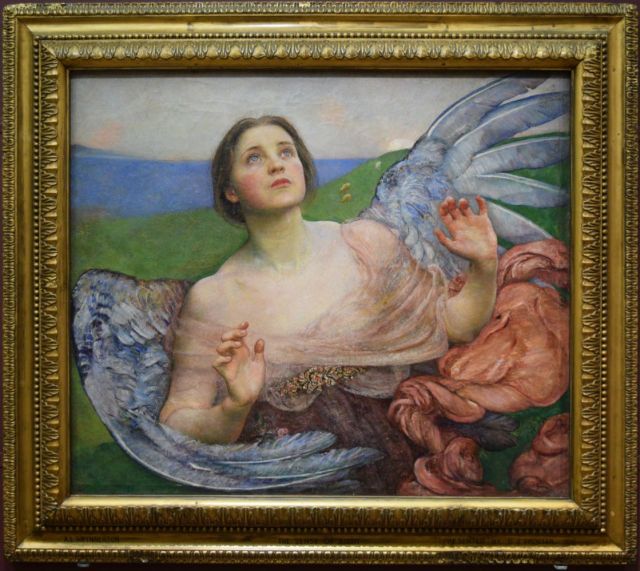
Images of other, otherwise ‘untraced’ works can been found in old auction catalogues, newspapers and other publications. Pieces occasionally appear at auction, typically once or twice a year. A handful of pieces are known from private or vendor collections which have been loaned to galleries for exhibitions or about which the owners have kindly contacted this web site. The total number of works by Annie for which there are images on this site is now over one-hundred-and-fifty and for Isabel just over fifty (Feb 2026).
[Note: ‘banner’ images at the top of this page are from past, not current, exhibitions at various galleries. The photo of A. L. Swynnerton is from Sylvia’s Journal magazine, June 1893, and thanks to Mike Stewart for the photo of S. I. Dacre.]
CAN YOU HELP? It would be wonderful to rediscover some of the lost works of Annie and Isabel.
If you own or know of any works by Annie Louisa Swynnerton (née Robinson) or Susan Isabel Dacre, or have any information or observations of interest, I welcome emails at:
swynnerton.blog@gmail.com
My sole interest is to display images of the works of Annie and Isabel and shed a little extra light on the artistic scene of the period. All communications are treated in strictest confidence. No personal information regarding ownership or location of privately-owned works is ever displayed on this web site.
Recommended reading:
- Christine Allen and Penny Morris (2018) Annie Swynnerton Painter and Pioneer. Sarsen Press.
- Susan Thompson (2018) The Life and Works of Annie Louisa Swynnerton. Manchester Art Press Limited.
- Katie Herrington and Rebecca Milner (2018) Annie Swynnerton: Painting Light and Hope. Manchester Art Gallery.
- Elizabeth Crawford’s web site Woman and Her Sphere contains much information relevant to Annie, her associates and relevant events of the period.
Highly recommended is a visit to Manchester Art Gallery where works by Annie and Isabel can be seen, Liverpool Art Gallery which has Annie’s Sense of Sight and the Tate which has seven works. Note that only a small number of the paintings held by any gallery are on display at any one time or that works may be on loan to other institutions, but these are all world class galleries with plenty of other wonderful things to see.

About me: my interest in Annie’s work started after visiting the Painting Light and Hope exhibition at Manchester Art Gallery in 2018 and wondering what other works by Annie are still in existence. I created this web site to share my interest and findings, which has since led to the rediscovery of several lost or unknown works and new information about existing ones, as well as an improved appreciation of the work of Susan Isabel Dacre. My other interests include supporting the veterans’ charity I work for, walking, running, travelling, photography and occasionally sketching.
Jonathan Russell, February 2026 (swynnerton.blog@gmail.com).
Web site registered 18 Oct 2018. This page last updated 31 Aug 2026.

