

Click HERE for the pictures.

From the time they met at art school, Isabel (she was generally known by her middle name) and Annie were friends, travelling, studying and creating art works together in Britain and on the continent.
Earlier in their careers Isabel’s work drew the most attention. Newspaper reports from exhibitions in the 1870s include comments such as, “Miss Dacre’s work is as far removed as possible from the ordinary standard of young lady’s art” and “we are strongly inclined to think that the work before us indicates genius”.
Isabel was the first to be exhibited at the Royal Academy in 1876, Annie first appearing in 1879. Upto 1906 when both were in their early 60s they were equally represented with 10 works each (and Annie’s husband Joseph 9), but thereafter Annie became a regular exhibitor with a further 51 works accepted over the years, Isabel with only a single work in 1929 (her untraced Sunset at Ronda).
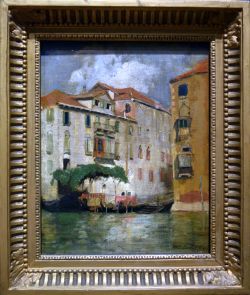
While being a gifted figurative, portrait and landscape artist, Isabel never, as far as is known, branched into symbolism like Annie. She regularly exhibited at the New English Art Club in the early 1900s, almost all landscapes with titles such as In the heart of the Apennines, Spanish Mountains, The Misty Ochills and Spoleto from the Cappucini. However, as time went by she had fewer and fewer works in exhibitions generally and there are reports of her suffering ill health in her later years. (There is a detailed biography below and contemporaneous records of her activities in the biographical notes section.)
As with Annie, Isabel’s works tended not to find their way into public collections. Today there are only twenty-four in public galleries, all in England, and none known abroad [apart from a drawing, Portrait of a young girl in a satin cap, said to be in the ‘André del Debbio Collection’ in Paris, the current whereabouts and accessibility of I haven’t been able to determine].
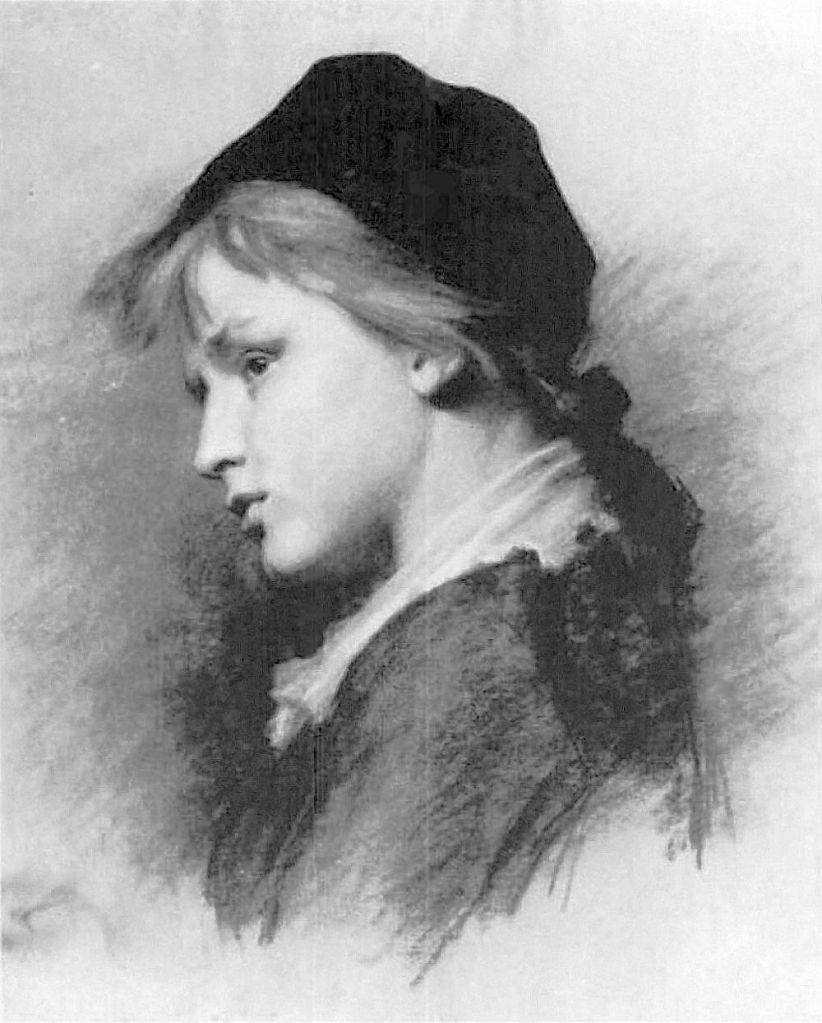
The number of works for which there is an image on this web site is now forty-two (May 2025), including five previously unrecorded works. Sincere thanks to the owners for contacting the web site and allowing the images to be shared, sheding light on the creativity of this remarkable but neglected artist.
If you own or know of any works by Isabel, or have any observations of interest, do email me at swynnerton.blog@gmail.com.
All communications are treated in strictest confidence. No personal information regarding ownership or location of privately-owned works is ever displayed on this web site.
Biographical sketch from The Manchester Guardian, 21 Feb 1933.
MISS S. ISABEL DACRE
We regret to announce the death of Miss Susan Isabel Dacre, the painter. She died at Blackheath yesterday, three days after entering her ninetieth year.
Miss Susan Isabel Dacre was born in Leamington on February 17, 1844. She was brought to Manchester in her infancy and was educated at a convent in Salford, and continued to look upon the city as her home till November, 1904, the date of her final departure to London. Of the sufferings and hardships of her earliest years she could never be persuaded to speak, but in 1857 her widowed mother became the landlady of the Stamford Arms, Altrincham, and the family settled down in comfort. The inn, as such, has long since disappeared, but it was here that Anthony Trollope stayed on his visit to the Art Treasures Exhibition held in Manchester in that year. Miss Dacre used to recall how he sat all morning in the deep bay of the snug, writing, writing, apparently endlessly writing, surrounded by a litter of papers, and how, after lunch, he would beautify himself — he had a great taste in waistcoats and spats — and make off to the exhibition. He was finishing the MS. of “Barchester Towers” at the time, and lent it to the family to read, an early association that made the book one of Miss Dacre’s favourites.
For the next twenty years she lived, for the most part, abroad, 1858-68 in Paris, at school, first as pupil then as governess. In 1869 she spent her first winter in Italy. Being in Paris in 1870, she, like other foreigners, was sent home on the outbreak of the Franco-Prussian War, and, returning again too soon, she and her brother were “caught in the Commune, forced to build barricades, and were with difficulty extricated from a perilous situation.
It was almost by accident that she found herself an artist, though she had passionately desired to follow that profession. A friend suggested that in the intervals of teaching they should copy pictures in the Louvre, a suggestion which resulted in such a wonderful copy of De Heem that Miss Dacre resolved to devote herself altogether to the work. From 1871 to 1874 she was in Manchester, where her mother was now landlady of the Ducie Arms, Strangeways, and during these years she attended classes at the School of Art, Cavendish Street, under the direction of Mr. W. H. Muckley. In 1874 she went to Rome with her lifelong friend Miss Robinson, afterwards Mrs. A. L. Swynnerton, and remained there two years. From 1877 till 1880 she was again in Paris a fellow pupil with Marie Bashkirtseff, and bracketed with her as first in the concours mentioned in the famous Diary. She was in London with Miss Robinson from 1880 till 1883, and on the marriage of the latter she returned to Manchester, where she continued quietly to practise her art till her removal to London in 1904.
She took an interest in the Women’s Suffrage movement, was an intimate friend of Miss Lydia Becker, whose portrait she painted, and sat on the local committee. She was president of the Manchester Women Painters’ Society, which she founded with Miss Robinson, and was an active member of the Manchester Academy of Fine Arts. She was very successful as a painter of children, and her Italian landscapes, which she began to produce in 1899, have a grave, serene, and intimate beauty not readily appraised by casual sketchers and tourists.
She was of an affectionate, unselfish, and humorous disposition, with a great capacity for friendship; her humility was pathetic — a result of the earliest years, — and though at times, if her affections’ were involved, she was capable of most spirited actions, her humour, playing round any situation affecting herself, exercised a crippling effect; But to her friends it was as the pinch of salt on the tail of the bird, stopping a foolish flight before it began. It lurked in the shyest of corners and stole from ambush in the most delight ful way. Her absent-mindedness was a source of delight and fun to all her intimate circle. She had even been known to walk off with an old woman’s basket of eggs that in her kindness she had offered to carry down the steps of Knott Mill station and her despair at losing her spectacles; an event which happened at least three times a day, was as heartrending as her joy at finding them again was hilarious. She was widely read in all the literature of Europe, and was a keen judge of a novel or poem. Her love for the theatre was intense. She would rather be present at a bad play than not at all. But it was for France and French things that she cared most of all. “Why don’t we understand the French better?” was a phrase constantly on her lips. She knew all the vicissitudes of fortune, but in every circumstance she remained the same large-minded, sympathetic, humorous, and generous woman.
Her picture “Little Annie Rooney” was purchased by a number of friends and admirers, and presented to the City Art Gallery in 1910. The Gallery has since acquired several more examples of her work — notably “Italian Women in Church,” a study of two heads, very delicately and affectionately handled, and a bold painting of three white swans. In the autumn of 1927, an exhibition of her work — along with that of two other artists — was held in the Gallery, and gave Manchester people ,the opportunity to appreciate her as a painter of landscapes. One of her Umbrian landscapes is now hanging in the annual exhibition of the Manchester Academy.
The Manchester Guardian, 21 Feb 1933, p4.
Note on Isabel’s family paintings and her brother William’s descendents.
Isabel Dacre painted pictures that included the children of her brother William (abt. 1842-1899) as well as her mother, Susan Wyatt (abt. 1816-1898). The works of her brother’s children include:
- Edith Susan Dacre (1875-1961) is the subject in A Morning Call in the ‘fifties’ I was told in 1985 by a descendant of William Dacre (the painter’s brother) that the subject was Edith Susan Dacre (1875 – 1961) William’s eldest daughter. Edith married Edward Willaim Cooper in 1898 and had 3 children with him. She died in Denbigh Wales where she and her family had resided for years. This painting is very likely the same as Portrait of a Girl Wearing a Bonnet. It is noted that there is a portrait “Susan” which is unlikely to be her as documents show her as Edith not Susan.
- Sarah Louise “Sally” (1879-1969) and Catherine “Kitty” (1882-1963) appear in a painting labelled “Portraitof Sally and Kitty Dacre / Two girls with yellow flowers” currently in private hands.
- Isabel (Susan Isabel “Isabel” Dacre) (1888-1972), William’s eldest daughter, is the subject in “The Rain it Raineth Every Day” and in “Portrait of a Little Girl in a Bonnet”.
- Henry Hugh “Harry” (1887-1977), may well be the subject of the portraiture “Henry Hugh”, exhibited in 1888 at the Manchester Academy exhibition.
- “The Artist’s Mother” is a portrait of Susan Wyatt, (abt. 1816 -1898) later Susan Dacre, later Susan Race (the wife of Henry Hugh Race (1806-1873) whom she married in 1858). The subject is the mother of the painter, Susan Isabel Dacre; the painting is inscribed “Dear Mamma”.
William had two more children. William Aylett “Aylett” (1877-1920) and Edith Susan (1875-1961) who may yet appear in the paintings of Miss Dacre. It is noted that there is a portrait “Susan” which is unlikely to be her niece Edith Susan Dacre as documents show her as Edith not Susan.
Similarly, the painter Susan Isabel Dacre and her older brother William had other siblings:
- Eliza Anne (1847 -1922) had 7 children with William Henderson, born between 1872 and 1885
- Louisa Mary (abt. 1849-1902) had 6 children and 2 spouses. The portrait “Winifred” is unlikely to be that of Winnifred Francom (1884-1962) as the portrait was painted in 1882.
- Marion Frances “Fanny” died a widow with no known children.
Perhaps paintings or portraits were done of these or other relatives, but have not been identified yet.
Mike Stewart.
A family tree created from the above and additional information from Mike Stewart:
- Mr … Dacre = Susan Isabel Wyatt (later married Henry Hugh Race (1806-1873) 1858).
- William Dacre (c. 1842-1899).
- Edith Susan Dacre (1875-1961).
- William ‘Aylett’ Dacre (1877-1920).
- Sarah Louise ‘Sally’ Dacre (1879-1969).
- Catherine ‘Kitty’ Dacre (1882-1963).
- Henry Hugh ‘Harry’ Dacre (1887-1977).
- Susan Isabel Dacre (1888-1972).
- Susan Isabel Dacre (the artist, 1844-1933).
- Louisa Mary Dacre (c. 1849-1902; married twice).
- Six children.
- Eliza Anne Dacre (1857-1922) = William Henderson.
- Seven children born between 1872 and 1885.
- Marion Frances ‘Fanny’ Dacre (c. 1851-1896) = James Henry Garstang (d. 1881; no known children).
- William Dacre (c. 1842-1899).
Page last updated 20 Feb 2026.
 ANNIE LOUISA SWYNNERTON and SUSAN ISABEL DACRE (1844-1933)