
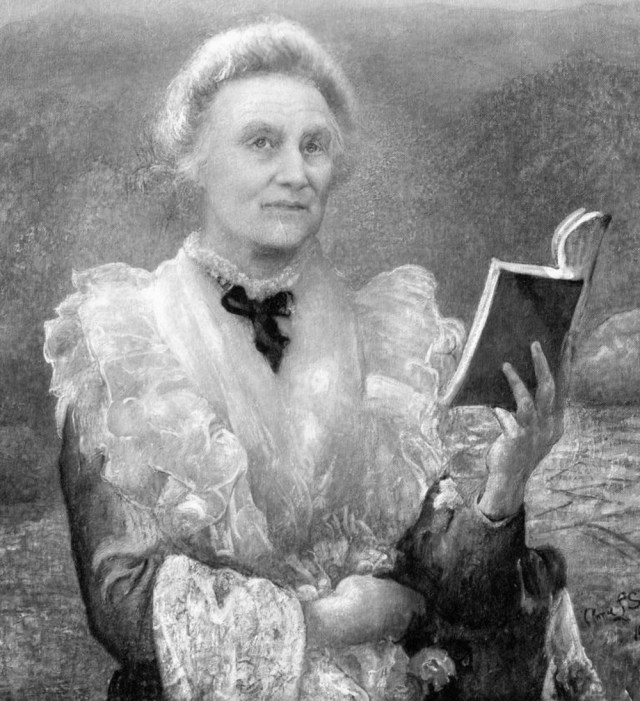
Annie’s Portrait of Alice Woods (1849-1941), painted about 1911, is believed to have been destroyed during a WWII air raid. Thankfully a photograph of the work exists.
Alice Woods, M.A., was a pioneering educationalist, promoting co-education, male and female students together, and establishing the first professional training program for women teachers at the Maria Grey Training College.
In 1940, aged about 90, she privately published a twenty-page pamphlet called ‘How to Grow Old’, which I’ve been very fortunate to obtain a copy of. As someone just entering his seventh decade, I was curious to see what she had to say on such matters. It was an interesting read and although rather outside the scope of this web site I felt it deserved to be put on record.

Alice divides old age into three ‘stages’, ‘Young Old Age’, 60-70, ‘Middle Old Age, 70-80, and ‘Old Old Age’, 80-90, not commenting on anything beyond that.
I would describe the pamphlet as rather prescriptive of each stage, but I suspect this stems from a teacher’s habit of wishing to simplify things for purposes of clarity and disambiguity. I’m sure she would have recognised there could be much variation between individuals. All the same, she had been contemplating the subject for a number of years, so undoubtedly had much personal insight and experience.
She states the pamphlet to be intended for “spinsters who have had some kind of career and who retired about the age of 60 and are likely to have before them an old age of twenty or even more years”, but I did find the subject matter applicable to a wider audience, female and male.
Alice advocates planning well ahead for one’s retirement and establishing good habits early on, to “keep up in some form the joys of our life work, or carry out schemes we have had no time to deal with [while employed]”.
There is an emphasis on maintaining physical health, “… we must give attention to the preparation of our bodies for their later period”, and for the increasing benefit of periods of rest as years advance, including the occasional whole day in bed. She recommends seeking medical advice regarding general bodily maintainance. There is no strong emphasis on physical exercise as such, Alice saying that it may be unwise to take up new activities such as “rowing, swimming or motor-cycling, or car-driving”, gentler intellectual or craft-based pursuits being her preferance, although she does note that some people retain their physical abilities long after others have lost theirs.
In considering life in the more advanced years, Alice emphasises the need for acceptance of personal limitations and increased dependence on others, while encouraging keeping as much autonomy as possible.
The mind may not work as well, she says, commenting on a tendency for increasing forgetfulness, but saying this should be approached with humour and the ability to laugh at oneself when caught out on occasion. Perhaps she is writing autobiographically to a degree, also saying, “there are certain compensations which, though not very numerous, may be looked to with a smile. In the first place there is a steady decline in the emotions of younger days. To many of us there comes a welcome loss of the trying self-consciousness of younger days … shyness, timidity and reticence … Though there are undoubtedly happy mortals to whom self-consciousness is an unknown experience”.
On loss, she reflects that with age comes the “mitigation of the intense pain suffered in childhood and youth by the loss of loved ones … we do in a measure recover from sorrows and sufferings of all kinds and that new love and new friendships can be ours …. The older we are the greater is our wealth of precious memories … the beautiful things we have seen and the delightful people we have met as the years flew by.” She reflects elsewhere on “the loss of friends” through death or the inability to travel to see them, but that there is “always the possibility of forming new friendships with younger men and women.”
Alice writes in some detail on how a person should not become insular or self-absorbed and on general matters of personal conduct, especially the avoidance of gossip, describing it as “anything that is said that would lower the person spoken of in the estimation of the listener”.
On religion she says, “We may have accepted the religion of our childhood, or completely modified the same, but some of us are still uncertain, and some remain seekers to the end. … Some of us believe Love is the greatest of all things …” and that for others simply to be of service to others is their ‘religion’. She makes a single biblical reference, “It is St. Paul who urges his followers to be ‘forgetting those things that are behind and reaching forth unto those things that are before’ … let our minds dwell on things that are honest, just, pure, lovely and of good report.”
There is a paragraph towards the end which I would love to have known more of her thoughts on:
… it seems that the present tumult of the world is caused by our arrival at the crossroads of a new evolution. One road is the road of mechanism. The machine is to be supreme, and the master of man, who is but a cog in the machinery of the world. This road leads to a blind alley without hope of advance. The other road is the road that leads to superman, to beings so superior to the present that we cannot even imagine them. Advance along this road is unending. It is spiritual instead of material, and for guidance we must look to mysticism, higher mathematics, music, all arts, and the ‘best rare moments’ of individuals.
What qualities did she imagine such super-individuals would possess? What form of ‘mysticism’ was she referring to?
Alice’s general philosophy in life might be summed up by the phrase used as a subtitle on the inside cover, “accept conditions, accept others, accept oneself” (which she attributes to an unidentified ‘eastern saying’).
She concludes, “These articles have been written because the writer became more and more convinced that a great deal must be done in earlier life to prepare for old age and to fit us into our surroundings … We are anxiously in the midst of devastating war [because] we have aimed at competition rather than co-operation, and have thus allowed selfishness and pleasure-seeking to be paramount rather than Service … When true co-operation comes there may be in reality on earth a Kingdom of Love, Beauty and Truth, in which all may be thankful to abide from birth until death.”
A copy of the pamphlet can be read or downloaded below. I’m not aware of any copyright issues and I think this privately published work deserves wider recognition, especially since so few copies must exist.
Page last updated 28 Mat 2025.
 ANNIE LOUISA SWYNNERTON and SUSAN ISABEL DACRE (1844-1933)