

I am gradually going through all the source material I hold to (1) create a reasonable catalogue raisonné, and (2) make sure the material presented on this web site is referenced as well as possible. Have just reviewed some newspaper articles from the early 1930s. They shed light on Annie’s home life on Hayling Island, where she moved in 1931. She relates thoughts on her career, her love of outdoor light and the importance of the company of her unnamed maid and the dog Marcus.
Pictures in one article show her by the unfinished Portrait of a lady holding a flower, and in another by a work I had been calling ‘1931 photograph‘, but which is evidently her An Image of Desire from the article texts (so has been renamed on this web site accordingly.). Photographs from other sources of the same work show it at different stages of development.

Reference is also made to a “portrait of a general … an officer of high rank in uniform gazing at a glorious glimpse of Kentish scenery … a general officer, a famous man”, the piece being named Home Once More, and which she hoped to finish and have exhibited at the Royal Academy. Unfortunately this never came about and Annie passed away 24th October, 1933, eight months after these articles were published. It might be possible to narrow down the identity of the officer involved. It would take a fair bit of detective work, but potentially it could still exist in a private family collection.
The reference for the first article below, ‘Interview in The Star, 26th March 1932, extracts from the archive of David Brownlie’, is from Allen & Morris (2018)1, in which the article is reproduced on page 151. I do wonder if the date should be 1933 and not 1932, as it appears contemporaneous to the other articles reproduced here.
[1 Christine Allen & Penny Morris (2018) Annie Swynnerton Painter and Pioneer, Winchester: Sarson Press. Out of print, but can occasionally be found at Amazon, eBay or abebooks.co.uk.]
The third article below is particularly well-written — a shame it is simply credited to an anonymous ‘special correspondent’ – detailing some of Annie’s deeper reflections on her life and career, a little moving even as she terms herself “an old lady who is so lonely now”.
The Star, 26 Oct 1932.
“DESIRE” PICTURE BY WOMAN OF 87.
Winged Figure Symbolising Mankind’s Yearning.
ACADEMY EXHIBIT?
Elderly Artist’s Love Of Open-Air Studio.
IN a South Kensington studio stands and exquisite picture of a winged figure symbolising the eternal yearning of the moth for the star.
It has been painted with loving care by a woman who is 87 years old. And she has called her picture “Desire.”
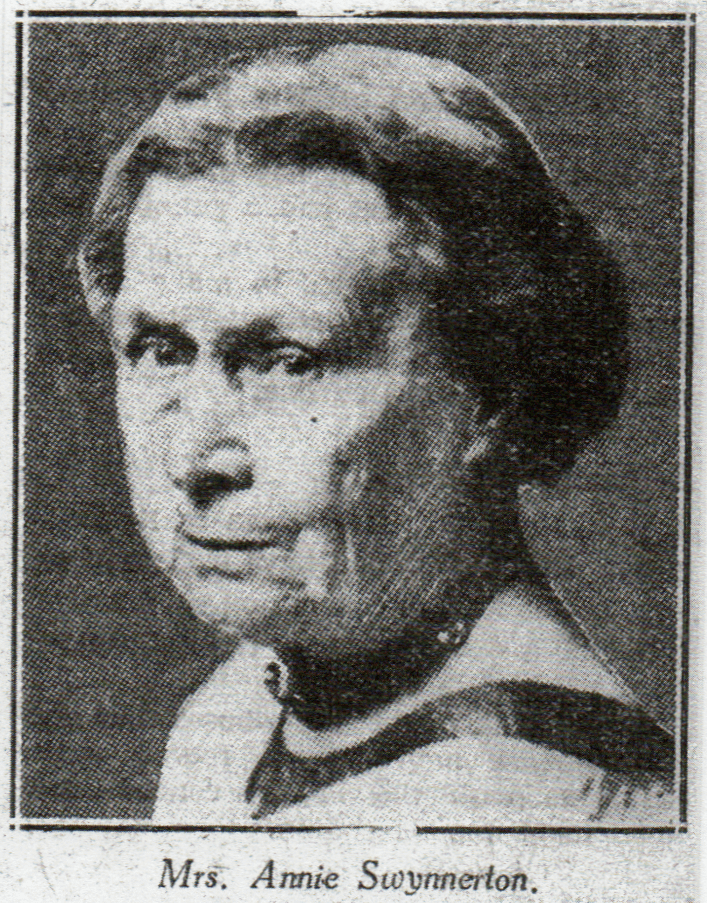
The artist, writes a “Star” reporter, is Mrs. Annie L. Swynnerton, who was the first woman A.R.A. to be elected since 1768, and is still a force in the world of art. She is the widow of the well-known sculptor, and was an intimate friend of Burne-Jones, Sargent, and a hundred other famous Academicians.
Finishing Touches.
When I saw her in her studio, Mrs. Swynnerton, a short, brisk little figure wearing her years with incredible ease, was putting the finishing touches to her picture, “Desire,” which is intended for submission to this year’s Royal Academy.
“Of course, I’m a hard worker,” she told me smilingly. “When one can do anything worth while at all, time is only too short.”
Almost every day this veteran artist is busy with her brush and palette. Two of her most recent pictures were accepted by the Manchester Academy for its spring exhibition.
The theme for “Desire” first appealed to Mrs. Swynnerton some years ago, and two years have gone by since it was begun.
“In the winged figure,” she said, “I have tried to express the desire of the moth for the star – the ‘something’ we all strive for in this life, but never attain.
Love of the Sea.
“It has not been a simple task, and I shall send it in only if I am satisfied with it.”
Mrs. Swynnerton has just returned from Hayling Island where she has been living in a bungalow and working strenuously.
“I love the sea” she told me; “at least from the shore! And I have been able to do some satisfactory work there.”
Mrs, Swynnerton does practically all of her painting – even portraits – in the open-air.
“I have always worked in the open as much as possible,” she added. “It helps one to get over the difficulties of changing light.
Turner’s Favourite.
“The only trouble is the uncertainty of the English weather, which sometimes makes portrait painting in the open rather disconcerting.”
A striking example of this type of work is another picture Mrs. Swynnerton proposes to send to the Academy.
It is called “Home Once More,” and depicts an officer of high rank in uniform gazing at a glorious glimpse of Kentish scenery.
“That view was Turner’s favourite,” the artist added.
Mrs. Swynnerton has a hatred of publicity.
“Burne-Jones once told me that I should be famous after I dies,” she said. “But a certain amount of unwelcome prominence always seems to come to those who, for some reason, appear in the public eye.
“It is the work that live on after death – not the name.”
The Evening News, 13 Feb 1933:
AN ARTIST AT 87
Painting for This Year’s Academy
HAYLING ISLAND STUDIO

In a tiny bungalow almost on the beach of the southern shore of Hayling Island Mrs. A. L. Swynnerton, the first woman to be elected an Associate of the Royal Academy since 1768 and probably the oldest woman in the country, is at work on two pictures which she hoped to complete of the Academy in May.
Mrs. Swynnerton, who is 87 years of age, was made an Associate of the Royal Academy in 1922, and her native city of Manchester gave her a civic reception as a mark of appreciation of one of her most distinguished daughters. Mrs. Swynnerton, who is exhibiting at the Manchester Spring Show this year, has shown her work at Ottowa and many of the great continental art galleries and exhibitions. She has a studio at Fulham and another in Rome where her husband, who was a sculptor, built a house.
Mrs. Swynnerton said she came to Hayling about 18 months ago.
“I found the light in London was not good enough for my work and here I found excellent light, warm sunshine, a beautiful sea and the clear atmosphere which is so necessary for the artist’s work.”
When the weather is warm she prefers to work out of doors, but when it is too cold she works in a studio in the garden, which had been converted from a garage, or in the front room of her bungalow. In the front room she is at work on one of the paintings intended for this year’s Academy, which is called “An Image of Desire,” and in the studio in the garden is the second of her two pictures “A Portrait of a General.”
“Yesterday she lifted the shrouds which cover the unfinished pictures and allowed me a glimpse of her work,” writes an “Evening News” reporter, “but it was her-secretary companion, who has looked after her business affairs and her household for several years, who told me of Mrs. Swynnerton’s painstaking care of her pictures.
“She will paint a little one day,” she said, “and if she is not satisfied it will all be scraped off the next day and she will start again.”
Her Dog Marcus
Very few residents in Hayling Island knew that they had a distinguished artist living in the island. Occasionally one or two strollers have found their way by accident down the straggling lane which leads to her bungalow, and on a fine day have seen her working through the open doors of the garden studio, but few of these have realized that in the elderly artist was a lady who has known all the great figures of the art world during the last half century. On the few occasions when she had been induced to talk she will refer to many of the great figures of the past as if they were man and women of yesterday.
Most of the residents knew her better as the lady who walks down to the beach every fine day, accompanied by her companion and a huge pedigree Alsatian dog called Marcus. Marcus is probably better known than his mistress, who thinks the world of him, and when Mrs. Swynnerton is unable to take him out for a walk he is accompanied by her maid.
Between Marcus and Mrs. Swynnerton there is a great affection; in fact, Marcus, despite his great size, is the pet of the small household and a very faithful guard for the bungalow. A valuable dog. Mrs. Swynnerton will tell you proudly of his pedigree, and although he will make friends readily with anyone his mistress welcomes to her bungalow he can be a terror to unwelcome intruders.
Mrs. Swynnerton was born in Manchester, the daughter of Francis Robinson, a soliciter, and married in 1883 Joseph William Swynnerton, the sculptor. She was educated in Manchester and Paris and her works include “The Sense of Sight” (Liverpool Art Gallery), St. Martin’s Summer, “The Unrelenting Past” (Ottowa), “Mater Triumphalis” (Luxembourg), “Dream of Italy” (New York), “Hope” (Melbourne), “The Oreads,” “New Risen Hope” (Tate Gallery).
The Evening News, 15 Feb 1933:
A Lonely Woman Painter of 87 Looks Back on Years of Persecution
‘NEED THEY HAVE SAID THINGS THAT HURT?’
FIRST WOMAN ASSOCIATE OF THE ACADEMY
MRS. SWYNNERTON’S BRAVERY
FROM OUR SPECIAL CORRESPONDENT / HAYLING ISLAND, Wednesday.
ALTHOUGH she is struggling bravely against ill-health and failing sight, the senior woman Associate of the Royal Academy is trying hard to finish two paintings in time for the Royal Academy in May.
She is Mrs. Annie L. Swynnerton, who is 87, and to-day, in her little bungalow by the sea at Hayling Island, she told me of her joy in painting and of the sorrow it has brough her.
Her eyes were bright with unshed tears as she spoke of these last few lonely years.
“Nearly all my friends have gone,” she said, “those I knew and loved so well – Millais, Burne-Jones, G. F. Watts, and, best of all, John Sargent.
“My life has been so difficult. I have had to struggle so hard. You see, when I was young, women could not paint – or so it was said …
“I Fought …”
“The world believed this and did not want the work of women, however sincere, however good. I fought, and I suffered. Whatever fame or success, recognition or achievement has come to me, I owe it to John Sargent.
“He was a true friend. He believed in my work and put all his heart into making others realise that a woman painter could do something really orth while.
“When in 1922 they made me and A.R.A. [Mrs, Swynnerton was the first woman elected a woman Associate since Angelica Kauffmann in 1769], I think Sargent was even more pleased than I.”
Mrs. Swynnerton’s hands twisted restlessly, her voice trembled.
“I shouldn’t tell you all this … but … but why couldn’t people have been just a little kinder to me in those far-off days when I was young? Why need they have said so many things that hurt – that hurt still?
“Only my great joy in painting kept me alive then, just as it does now.
Happy Married Life
“I must thank God that my married life was so happy. Many hard knock were sheltered from me by my husband and my friends; now I have to bear them alone.
“But that is enough about my troubles. Come and see my joys – my pictures.”
At once Mrs. Swynnerton’s appearance seemed to change. No longer a tired old lady but an artist full of the joy of her work.
“It is lovely here at Hayling Island. The light is so good; I can see so much better than in London and the weather is so mild that I can work out of doors almost every day.
“See, here is the garage; it is now my studio. I can open wide the doors and put my canvas in the entrance – nicely sheltered and in good light.”
Gently, carefully, Mrs. Swynnerton lifted the sheet covering her half-finished picture.
“It is called ‘An Image of Desire,’” she said to me. “That’s Shelly, you know.”
“Softly she quoted the lovely lines.
“‘The desire of the moth for the star, / Of the night for the morrow; / The devotion to something afar / From the sphere of our sorrow.’
“How I love Shelly … indeed all the poets. All my work is inspired by poetry. Keats, too. …”
“My Soldier Man”
Almost to herself this gracious old lady repeated line after line of Keats.
“Keats reminds me of my own hard life. Why were people not kinder to me? Why did they persecute me so?
“But … he was only 23 when he died. I have lived on.
“Here is my soldier man. I mustn’t tell you his name before the Academy.”
Mrs. Swynnerton paused for a moment.
“If he ever gets there.” She added.
“I am trying so hard, but it is tiring – so tiring. He’s a general officer, a famous man, and the background is a lovely bit of Kent. I do want to finish it.”
Mrs. Swynnerton’s companion at Hayling Island is Marcus, a magnificent Alsatian dog belonging to the friend with whom she lives.
“Isn’t he lovely?” she smiles – almost for the first time. “And so useful too. He is our housemaid. He shakes all the rugs for us and puts them back in the right rooms. He brings in all the wood for the fires, too.
“We just say ‘Wood’ and off he goes.”
Then Mrs. Swynnerton bade me farewell. And as I left she called after me, “Think kindly of an old lady who is so lonely now.”
Jonathan Russell
Page last updated 20 Nov 2025.
 ANNIE LOUISA SWYNNERTON and SUSAN ISABEL DACRE (1844-1933)
Thank you for these touching and illuminating articles, Jonathan. I have copied the quote from the 1932 Star (“Of course I am a hard worker…When one can do anything worth while at all, time is only too short”) into the front of my 2026 engagement diary.
LikeLiked by 1 person