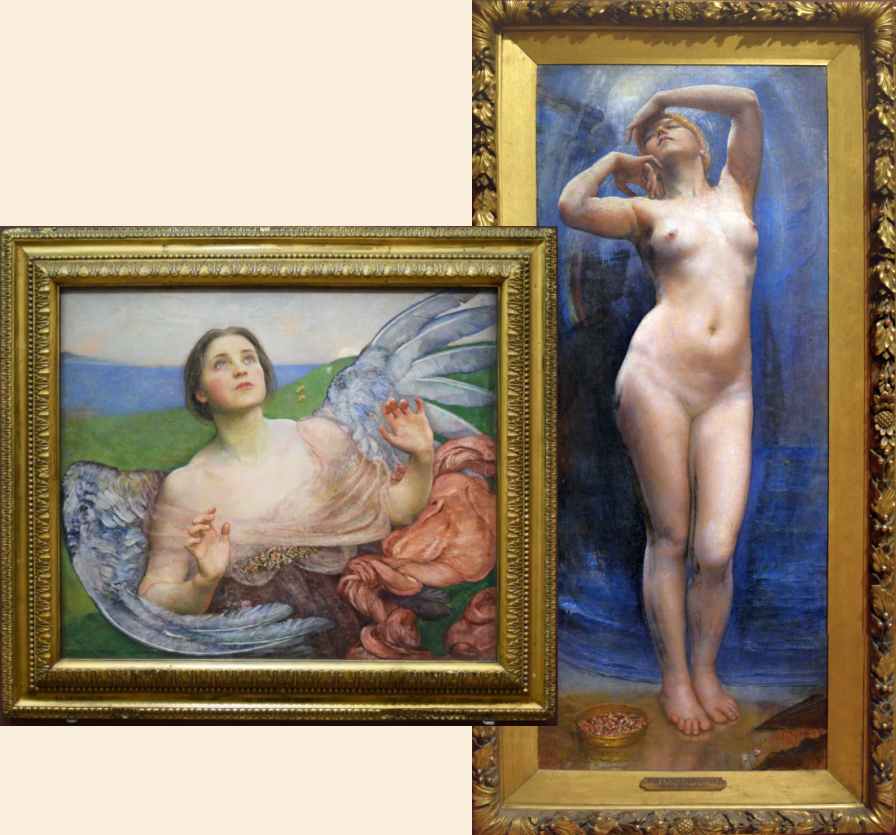
The Sense of Sight and Mater Triumphalis are currently on loan to The Clark Art Institute, Williamstown, Massachusetts, USA, for inclusion in their exhibition A Room of Her Own: Women Artist-Activists in Britain, 1875-1945 (14 Jun – 14 Sep 2025). [See also this page (archive.org), on which The Sense of Sight is shown, and berkshirefinearts.com article.]
This is the third occasion I’m aware of that Mater has travelled across the Atlantic, but the first occasion – unless I’m forgetting something – that Sight has ever travelled overseas.
Have to admit I was unaware of the The Clark, but after a bit of reading learned that it is a leading art institution on the global stage and with one of the largest collections of art publications in the United States, analogous to The Courtauld in some ways, except spread out like a rural university campus rather than being in the midst of a bustling city.
I was kindly emailed by one of the curators informing me of the exhibition, and commenting, “I have wondered whether Swynnerton was inspired [to paint Mater Triumphalis] by Algernon Swinburne’s poem of the same title”.
The poem referred to was published by Swinburne in 1871 in his Songs Before Sunrise. It is a work of four-hundred lines in forty verses, beggining …
Mother of man’s time-travelling generations,
Breath of his nostrils, heartblood of his heart,
God above all Gods worshipped of all nations,
Light above light, law beyond law, thou art.
Thy face is as a sword smiting in sunder
Shadows and chains and dreams and iron things;
The sea is dumb before thy face, the thunder
Silent, the skies are narrower than thy wings.
I found the poem a difficult read – it would take quite a bit of studying and understanding the themes in the author’s life to really understand the message or emotions involved – not an area I’m at all knowledgeable about.
I did read that the book in which the poem was published was in ways a political work related to the unification of Italy. It was dedicated to Giuseppe ‘Joseph’ Mazzini, a campaigner for Italian unity at a times when the peninsula was split into competing states often allied to foreign powers. It made me think how when Annie and Joseph moved to Rome in the early 1880s they were doing so at a time when Italy had only been a unified nation for a couple of decades after long periods of sometimes horrific conflict.
Annie is reported to have been “a passionate lover of poetry” (Cooper, A. B., Pearson’s Magazine, Mar 1923), with certain poems recognized as the inspiration behind individual works, but she sadly left no journals, letters or other writings to explain in any depth such matters. I personally suspect she would have been well familiar with the writings of Swinburne. His poem was written twenty years before her painting, so it seems a not unreasonable hypothesis that she had it in mind – but I’m not aware of any definitive evidence.
Any thoughs on the matter welcome: swynnerton.blog@gmail.com.
Footnote: Interestingly, in his publication The Duties of Man, 1860, Giuseppe Mazzini, much ahead of his time, emphasized the importance of women’s rights for self-determination in their daily affairs as well as those of ‘working men’. I’m sure Annie would have approved of his comments, if she was aware of them.
Jonathan Russell, with thanks to The Clark Institute – which also has an upcoming exhibition on Berenice Abbott, one of my favorite photographers.
 ANNIE LOUISA SWYNNERTON and SUSAN ISABEL DACRE (1844-1933)