
Image: gallery curatorial file.
- Title(s): St. Martin’s Summer (National Gallery of Canada).
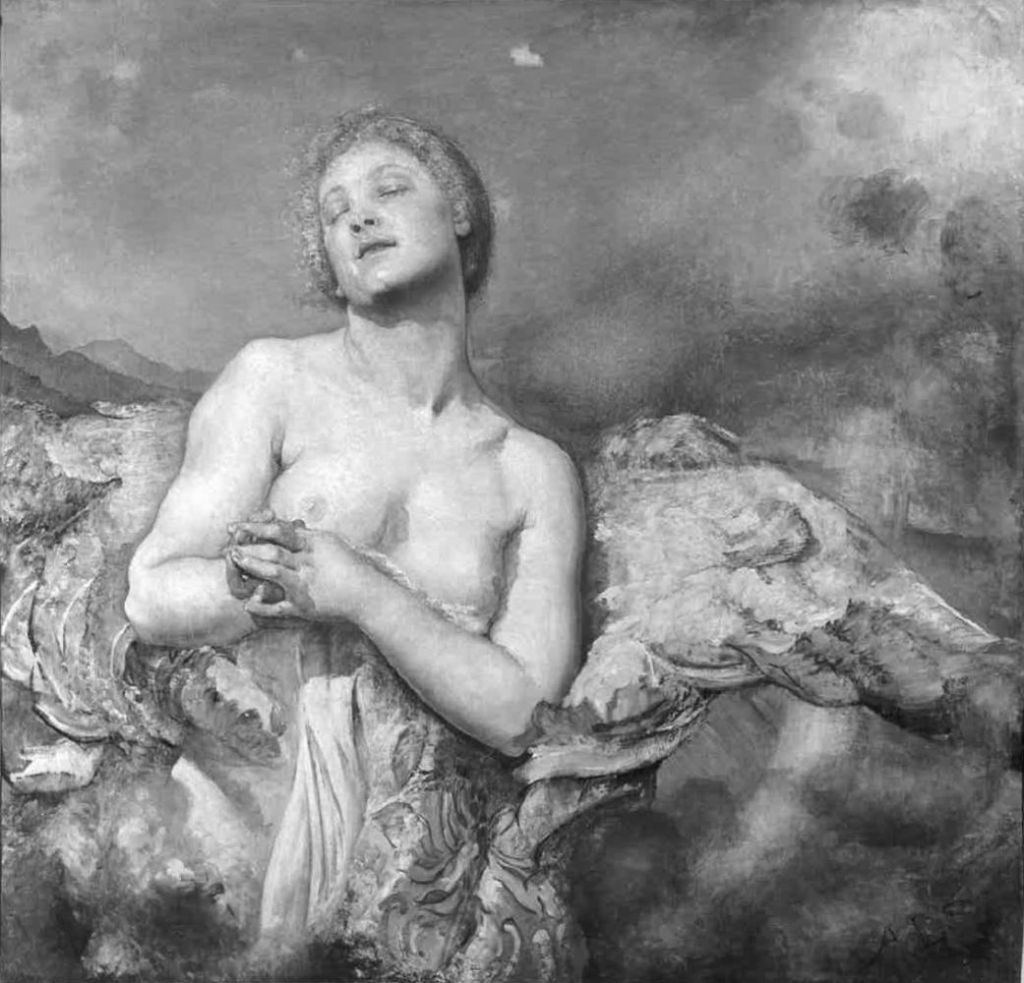
- Description: Upper torso of a winged female figure, eyes closed, her face tilted up and to her right and with a feint smile. Background a diffuse wash, mountains behind the subject’s right shoulder and the arc of a rainbow behind her left wing.
- Media: oil on canvas (National Gallery of Canada).
- Dimensions: “106.3 x 110 cm” (National Gallery of Canada).
- Signature/date/other text:
- History:
- 1898 Apr – Exhibited New Gallery (The Tablet, 30 Apr 1898).
- 1899 Feb – Exhibited Society of Women Artists, Suffolk Street, London (The Queen, 18 Feb 1899).
- 1900 – Exhibited Women’s Exhibition, Earl’s Court, 1900 (exhibition catalogue).
- 1909 – Exhibited New Gallery, Summer Exhibition (The Art Journal, 1909).
- 1910 – Manchester Academy Autumn Exhibition (reference?).
- 1922? – “the Liverpool Gallery” (Pearson’s Magazine, March 2023).
- 1922 – Purchased 1922 by the National Gallery of Canada (National Gallery of Canada).
- 1928 – Published image in Saturday Night (Canadian Newspaper), 26 May.
- Location: National Gallery of Canada, Ottowa.
‘St Martin’s Summer’ is a period of warm weather late in the year, St. Martin’s Day being 10 November.
Mrs Swynnerton’s ‘St. Martin’s Summer’ is a most glad and confident painting. It should be seen as a decoration, making a single space of radiant colour, free of the confusions of colours surrounding it in a picture gallery. Her art is careless of particulars in this, as in other of her paintings. The wings of flamingo red are not organic to the figure, the painting of the clasped hands is cruelly raw. But the breadth and purity of the conception, the rose-tinted face with its close crown of golden hair, the body fair against the deep airy blue of the sky, have sweetness in their strength. (The Art Journal, 1909, p253.)
Here, once again, she depicts a woman who personifies her ideal of ample and glowing womanhood, one who seems to drink the beauty of life with eyes closed – in an ecstacy of happiness. Seen from a distance in broadly-painted flesh tones – and even the strongly outlined purple shadow on cheek and neck – take their right place in the scheme. (The Englishwoman’s Review of Social and Industrial Questions, July 15 1909.)
Page last updated 7 May 2025.
 ANNIE LOUISA SWYNNERTON and SUSAN ISABEL DACRE (1844-1933)