
Images: artpaintingartist.org (frame: unattributed source).
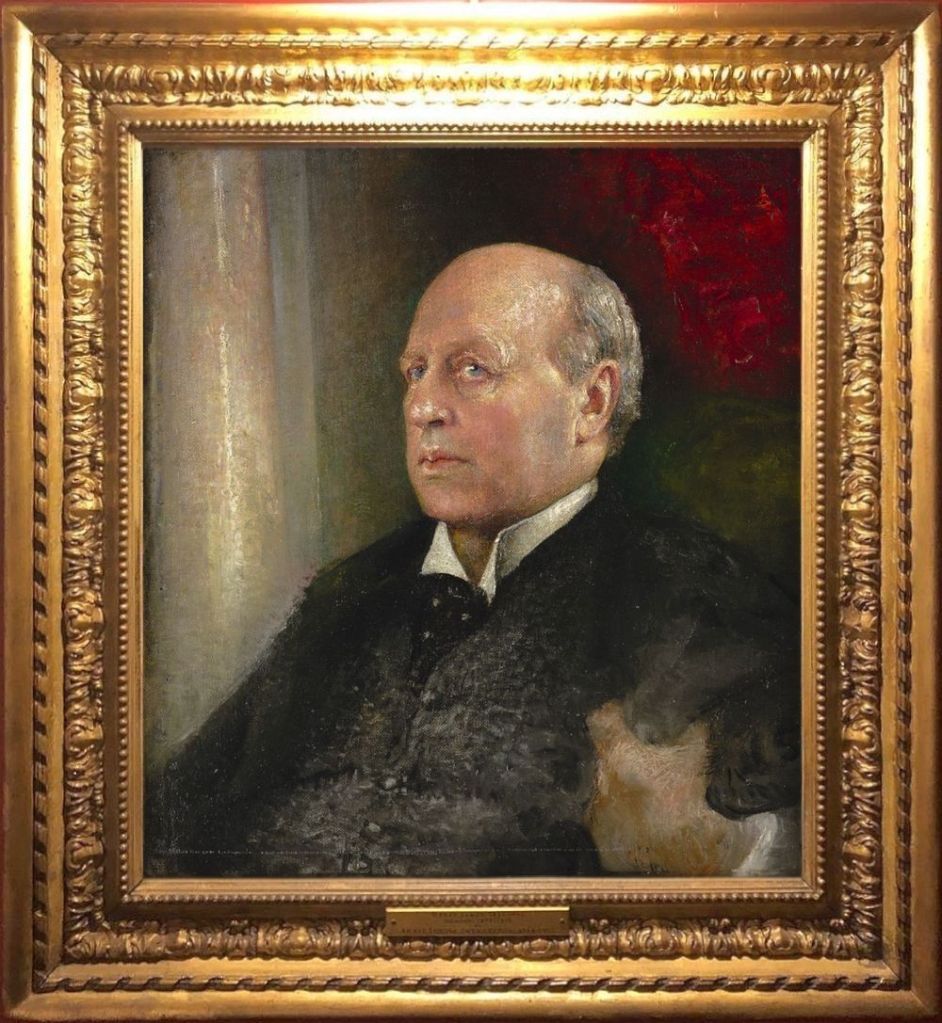
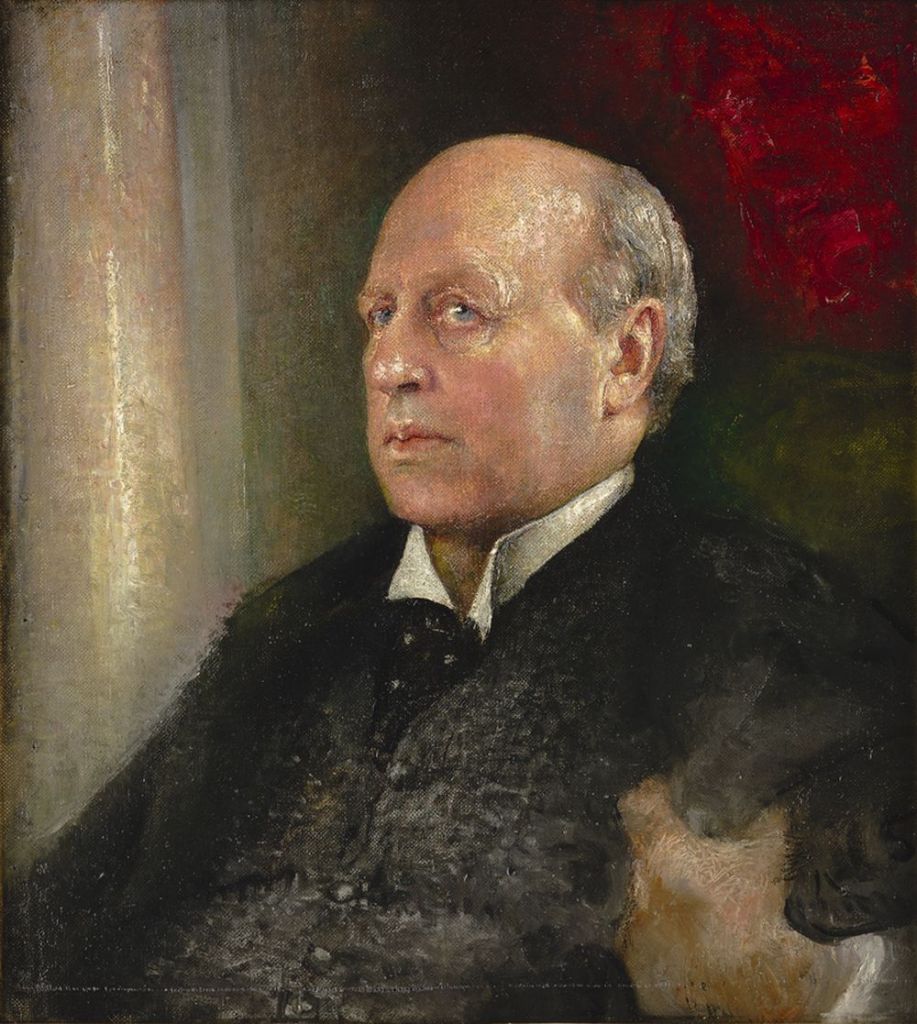
- Title(s): Portrait of Henry James (Christie’s, 2008).
- Description: Bust portrait of the author Henry James, seated three-quarters towards viewer, his gaze slightly upwards, detail away from the face and standing shirt collar indistinct, notably his left hand raised by his chest and holding a book, both hand and book having a blurred appearance.
- Media: Oil on canvas (Christie’s, 2008).
- Dimensions: “22 5/8 x 20 1/8 in. (57.5 x 51.2 cm.)” (Christie’s, 2008).
- Signature/date/other text: “inscribed ‘Portrait of Henry James/by MrsAnnie L. Swynnerton/1A The Avenue/76 Fulham Road/London. S.W.’ (on an old label attached to the reverse)” (Christie’s, 2008); no signature or date apparent on front of exposed canvas from available images.
- History:
- 1911 – Sometimes dated 1910, but Annie still working on painting Aug 1911 (Letters of Henry James).
- Late 1920s – “a Washington Post correspondent saw it [in Annie’s studio] in the late 1920s”. (Reference?)
- 1924 – Exhibited “Carnegie Institute International Annual Exhibit of Paintings” (Christian Science Monitor, 28 Apr 1924).
- 1932 – Exhibited Manchester (Posthumous studio sale catalogue).
- 1934 Feb 9 – Auctioned Christie’s, lot 73 (18 Gns to wilson) (Posthumous studio sale catalogue; Christie’s, 2008).
- 1939 – Exhibited Whitchapel (Christie’s, 2008).
- 2008 Sep 3 – Auctioned Christie’s, London, “Portrait of Henry James (1843-1916), bust-length, in a black coat / inscribed ‘Portrait of Henry James/by MrsAnnie L. Swynnerton/1A The Avenue/76 Fulham Road/London. S.W.’ (on an old label attached to the reverse)”, sold: hammer £7,000, premium £8,750.
- Location: Private collection.
In a letter written 27 Aug 1911, Henry James states that “Mrs. S. is also doing – finishing – the portrait of me that she pushed on so last year” (27 August). James is referring to the period 14 May to 1 June, 1910, when, during a period of severe depression, he was staying with the Hunters at Hill House.
“… the novelist and his sister-in-law visited Mrs. Charles Hunter’s at Hill House [1], in Epping Forest, where she had a perpetual salon. It was a splendid house, ninety minutes from London. Regular meals, good walks, a great deal of company helped HJ but his depression lingered. He watched his old friend John Singer Sargent decorate a portion of the house, met Sargent’s sisters, Mrs. Ormond and Emily, listened to the Australian virtuoso Percy Grainger play the piano – “a very attractive youth” – encountered George Moore, whom he pronounced “unimportant,” and saw other notables, Lord Ribbesdale, the actress Viola Tree, the young Harold Nicholson. He sat for his portrait, during the eighteen days he spent there, to Annie L. Swynnerton … ” [2].
In a letter of 24 of August, 1911, James commented that the portrait was “Painted with remarkable ability, but almost void of real resemblance”. [3]
Mrs. Swynnerton told me of an amusing experience she had when painting a portrait of Henry James while at a country house party. All the guests said it was a fine portrait, but each detected some little fault. The nose or the mouth or the forehead was not quite right. Madame Beckendorf, as she was leaving, said, “Dear Mrs. Swynnerton, you have done a fine thing, but you haven’t got his ear!” “Oh,” thought the artist, “now they have left me nothing!” Daily Mirror, 14 Aug 1929, p11.
A portrait of Henry James does not fear a background of glowing crimson and green.
The Manchester Evening News, 6 Jul 1923, p3.
… possesses the rare attribute of rounded masses. One is convinced that the head is more than a silhouette.
Christian Science Monitor,_28 Apr 1924.
Notes/references:
- Hill House was a centre of literary and artistic society in the 1890s and 1900s.
- Source: Leon Edel & Lyall H. Powers (1987) The Complete Notebooks of Henry James. Oxford University Press. pp312-313.
- Letter written by Henry James to Alice Runnells.
- From auction description: “sitting for an apparently unknown portrait begun fifteen months before by Mrs [Annie Louisa] Swynnerton (1883-1933, wife of the sculptor William Swynnerton) (”…Painted with remarkable ability, but almost arid of real resemblance…”) which he compares with [his nephew William’s paintings (William ‘Billy’ James II, who painted James earlier in 1911)], “… Bill’s great manner-in which resemblance marches so hand in hand with execution…”, and complaining about the dreadful heat and drought both in America and England (”… a blot on the fair face of dear old England, usually so cool & moist & green, so convenient & comfortable …”) and the general strike on the railways which had hindered his journey to the ”more umbrageous region” of Epping where he was staying with Charles Hunter (”… the wonderful place & its wonderful mistress are more wonderful than ever. The latter is a quite prodigious charming person-& still prodigious and charming have been so all her life …”), asking for a copy of his brother’s portrait of her (”the great work”) and recounting a visit to Audley End”. [Thanks to Michael Anesko, Pennsylvania State University, for corrections to the original text.]
- Inigo Thomas, London Review of Books, 27 Sep 2018 (www.lrb.co.uk/the-paper/v40/n18/inigo-thomas/at-manchester-art-gallery).
Page last updated 1 Sep 2025.
 ANNIE LOUISA SWYNNERTON and SUSAN ISABEL DACRE (1844-1933)