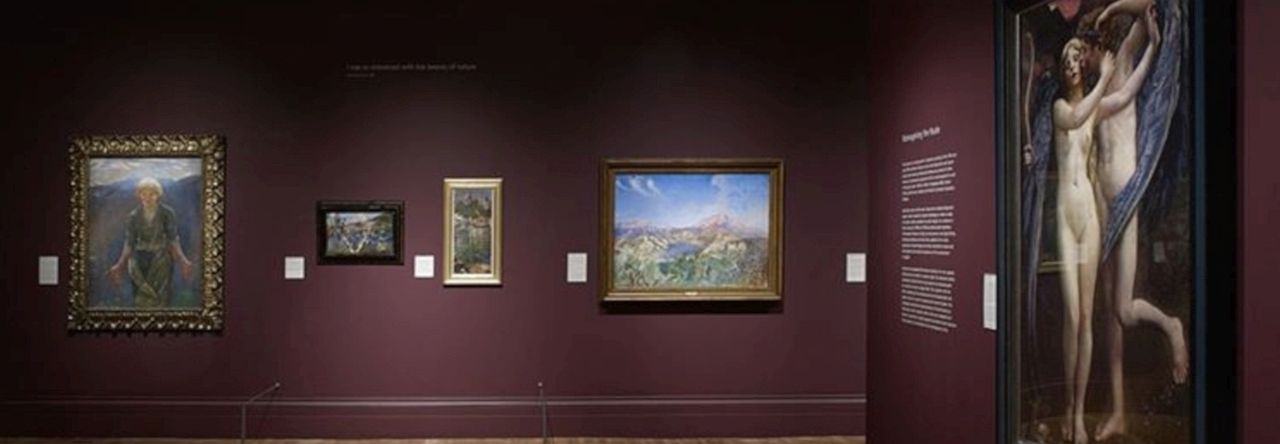

THE OXFORD DICTIONARY OF NATIONAL BIOGRAPHY (2004) entry on Annie is given below, written by Pamela Gerrish Nunn, a recognised expert on the period and subject area in general. It is remarkably rich in detail considering so little else had been witten about Annie at the time.
Swynnerton [née Robinson], Annie Louisa (1844-1933), artist, was born 26 February 1844 at 3 Vine Grove [1], Hulme, Manchester, one of the seven daughters of Francis Robinson, a lawyer, and his wife, Ann Sanderson. After training at the Manchester School of Art (from 1871), where she won a scholarship for watercolour and a gold medal for oil painting, she went to Paris; here she studied at the Académie Julian and admired the work of naturalist painter Jules Bastien-Lepage.
In 1874 she went to Rome with fellow Mancunian Susan (Isabel) Dacre for further artistic experience. She returned to her home town and in 1879 became co-founder with Dacre of the Manchester Society of Women Painters. This initiative was intended to supply the deficiencies of art training for women in the city.
With an introduction to Edward Burne-Jones, she made her debut at the Royal Academy in 1879, which was followed by annual appearances there until 1886, and again from 1902 until 1904. Other appearances in exhibitions were at the Society of Women Artists (1887): the Grosvenor Gallery (1882-7) and its successor, the New Gallery (1890-1909); the International Society of Sculptors, Painters and Gravers; and the World’s Colombian Exhibition in Chicago (1893).
On 6 July 1883 she married the sculptor Joseph William Swynnerton (1848-1910), son of Charles Swynnerton, and they subsequently divided their time between Italy and England; their London studio was in Shepherd’s Bush. After her husband died in 1910, her British base was a studio in Chelsea.
During her lifetime Swynnerton’s professional distinctions included associateship of the Manchester Academy (1884), membership of the hanging committee of the autumn exhibiton (1895), held at the Walker Art Gallery in Liverpool, and associateship of the Royal Academy (1922). In this last case she made history in so far as the RA had (controversially) elected no women to its membership since the founding academicians Angelica Kauffmann and Mary Moser in 1768.
Swynnerton became something of an ‘artist’s artist’, counting G. F. Watts, George Clausen, and John Singer Sargent among her admirers and patrons. Her painting was noted by both admirers and critics for vigorous brushwork and bold subjects, often using the full-length nude figure (Mater Triumphalis, 1892, Musèe d’Orsay, Paris), and abstract or ideal themes (The Sense of Sight, 1895, Walker Art Gallery, Liverpool). An independent styalist, she incorporated aspects of Pre-Raphaelitism, neo-classicism, and impressionism into her work over the years. She also produced much successful portraiture of men, women, and children (Henry James, 1910; Dame Millicent Fawcett, 1930).
A retrospective of fifty-nine of Swynnerton’s works was held at Manchester City Art Gallery in 1923. She became well represented internationally within her lifetime, with paintings entering the collections of the Metropolitan Museum of Art in New York, the National Gallery of Victoria in Melbourne, the Johannesburg Art Gallery in South Africa, and the National Gallery of Canada in Ottowa; in addition, the Tate collection has six [2] of her works.
Acquiring a reputation in her older years as a ‘character’ because of her independent style of dress, her forthrightness and indifference to conventions, and her candid enthusiasm for her work, she led a reclusive life for her last few years as her sight began to fail. She continued to paint until a few months before her death on 24 October 1933 at her home, Sicilia, in Beach Road, Hayling Island, Hampshire.
Source: Pamela Gerrish Nunn in Matthew H.C.G. and Harrison, B. (2004) Oxford Dictionary of National Biography (vol. 53), Oxford University Press, p530-1.
Notes:
[1] Still a residential road, but has been redeveloped with modern housing.
[2] With aquisition of the Portrait of Elizabeth Williamson in 2017 the Tate now has seven works.
Page last updated 28 May 2025.
 ANNIE LOUISA SWYNNERTON and SUSAN ISABEL DACRE (1844-1933)