
< 1920s
1930
[A friend travelled to Rome with Annie and] was stunned [when she saw Annies house] . ‘This is a wonderful house – so beautifully clean – wonderful – the roof garden and studios are delightful. The marble steps, the great doors, painted ceilings – all luxury. Why doesn’t Mrs S. live here always in comfort?’
Inigo Thomas (27 Sep 2018) London Review of Books, 40(18), pp28-9).
A comment in the Dundee Courier, 16 Apr 1929, p12 adds a little: “In Rome, Mrs. Swynnerton has a studio on the roof of the beautiful house which her late husband built years ago.”
1931
August(?) 1931: Annie moves to Hayling Island, Hampshire, to “a tiny bungalow almost on the beach on the southern shore … about 18 months ago” (The Evening News, 13 Feb 1933).

Annie photographed in 1931 (Royal Academy web site).
SEPTEMBER.
Letter … to the Editor of THE ARCHITECTURAL REVIEW, September 1931:
Sir, – Owing to illness I was unable to answer your letter of June 5 before.
(1) As A.R.A. I have a right to exhibit five works.
(2) The R.A. keeps up the standard of good workmanship.
(3) I think more space should be allowed to outside exhibitors, and perhaps members might have the courtesy and consideration not to exhibit the numbers of pictures they are entitled to, especially if they are of large size.
I think the Royal Academy is doing its best to uphold the standard of “Good Art,” but “Good Art” is not easy to find. It is a rare product.
There have been exhibitions in London and Paris of rejected works from the Academy and the Salon, and they have been such ghastly failures that the rejected themselves do not seem willing to repeat the experiment.
Faithfully yours,
ANNIE LOUISA SWYNNERTON.
1A Avenue Studios,
76 Fulham Road, S.W.3.
1932
MARCH
The Star, 26 Oct 1932.
“DESIRE” PICTURE BY WOMAN OF 87.
Winged Figure Symbolising Mankind’s Yearning.
ACADEMY EXHIBIT?
Elderly Artist’s Love Of Open-Air Studio.
IN a South Kensington studio stands and exquisite picture of a winged figure symbolising the eternal yearning of the moth for the star.
It has been painted with loving care by a woman who is 87 years old. And she has called her picture “Desire.”
The artist, writes a “Star” reporter, is Mrs. Annie L. Swynnerton, who was the first woman A.R.A. to be elected since 1768, and is still a force in the world of art. She is the widow of the well-known sculptor, and was an intimate friend of Burne-Jones, Sargent, and a hundred other famous Academicians.
Finishing Touches.
When I saw her in her studio, Mrs. Swynnerton, a short, brisk little figure wearing her years with incredible ease, was putting the finishing touches to her picture, “Desire,” which is intended for submission to this year’s Royal Academy.
“Of course, I’m a hard worker,” she told me smilingly. “When one can do anything worth while at all, time is only too short.”
Almost every day this veteran artist is busy with her brush and palette. Two of her most recent pictures were accepted by the Manchester Academy for its spring exhibition.
The theme for “Desire” first appealed to Mrs. Swynnerton some years ago, and two years have gone by since it was begun.
“In the winged figure,” she said, “I have tried to express the desire of the moth for the star – the ‘something’ we all strive for in this life, but never attain.
Love of the Sea.
“It has not been a simple task, and I shall send it in only if I am satisfied with it.”
Mrs. Swynnerton has just returned from Hayling Island where she has been living in a bungalow and working strenuously.
“I love the sea” she told me; “at least from the shore! And I have been able to do some satisfactory work there.”
Mrs, Swynnerton does practically all of her painting – even portraits – in the open-air.
“I have always worked in the open as much as possible,” she added. “It helps one to get over the difficulties of changing light.
Turner’s Favourite.
“The only trouble is the uncertainty of the English weather, which sometimes makes portrait painting in the open rather disconcerting.”
A striking example of this type of work is another picture Mrs. Swynnerton proposes to send to the Academy.
It is called “Home Once More,” and depicts an officer of high rank in uniform gazing at a glorious glimpse of Kentish scenery.
“That view was Turner’s favourite,” the artist added.
Mrs. Swynnerton has a hatred of publicity.
“Burne-Jones once told me that I should be famous after I dies,” she said. “But a certain amount of unwelcome prominence always seems to come to those who, for some reason, appear in the public eye.
“It is the work that live on after death – not the name.”
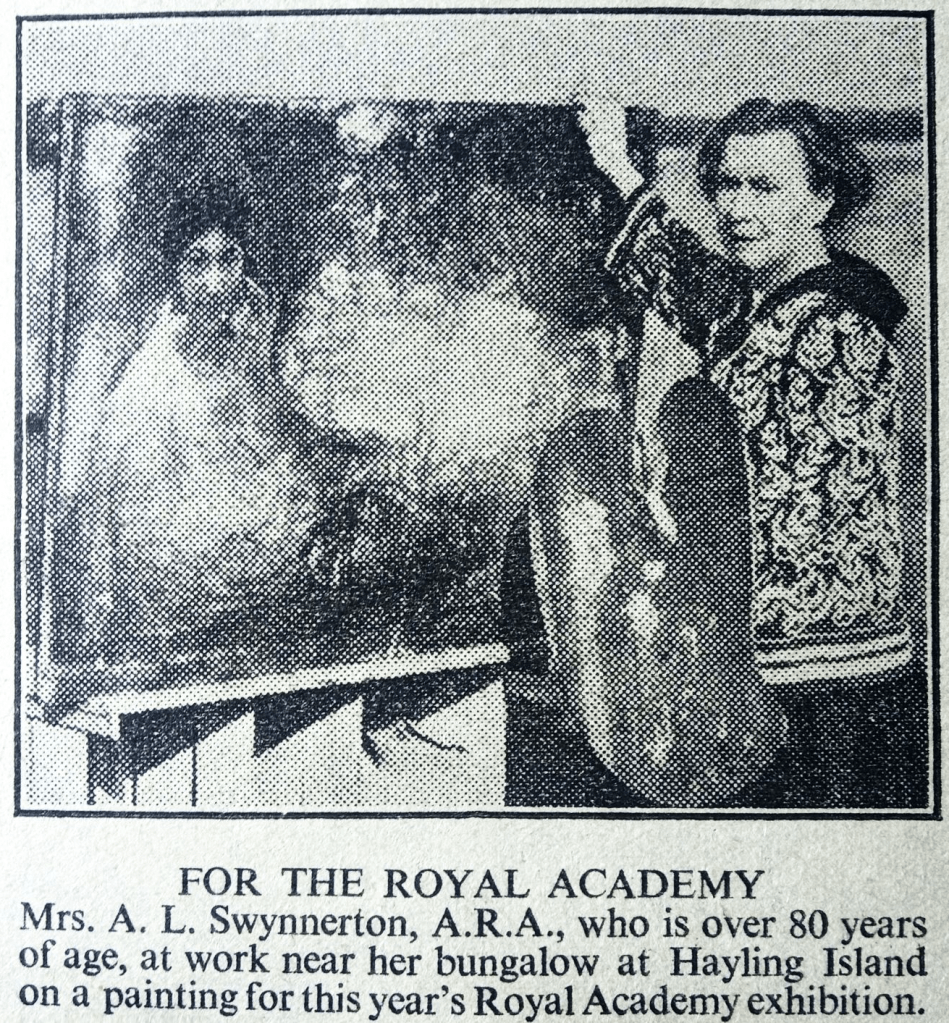
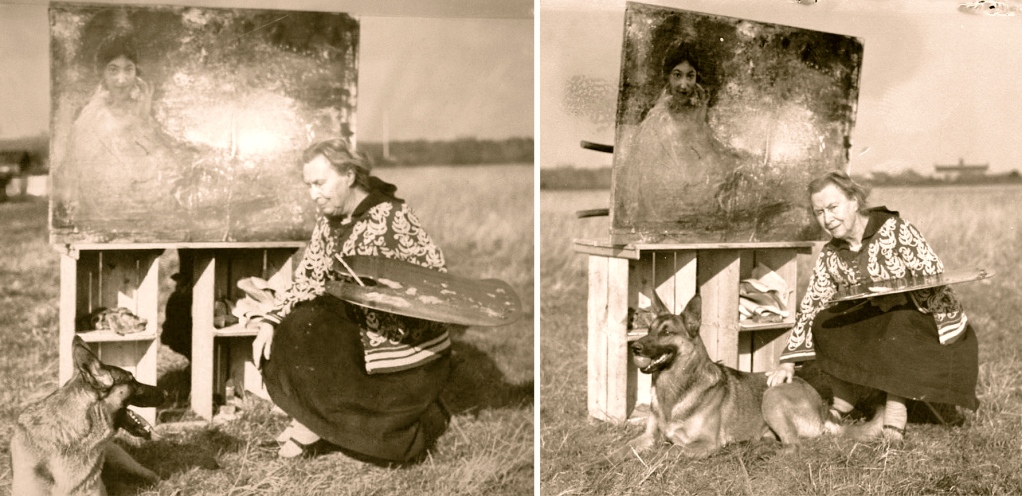
Annie at Hayling Island with her dog, Marcus. (Exact date of photo uncertain.)
WOMAN ARTIST AT 87
LONG HOURS IN HER STUDIO
In a small studio in a cul-de-sac off the Fulham Road, London, lives one of Englands foremost painters,
She is Mrs Annie Louisa Swynnerton, who, at 87, has just had two pictures accepted for the Spring Exhibition of the Manchester Art Gallery …
Mr John Tweed, the famous sculpture, who works in a neighbouring studio, said:-
“Although Mrs Swynnerton is 87 she paints for long hours daily in her studio and still sends pictures to exhibitions. I hold that she is the best living painter in England. At present she is at her bungalow on Hayling Island, Hampshire, painting by the sea.”
Mrs Swynnerton was born at Hulme, Manchester, in 1845 [error in original article], and began her training at Manchester School of Art. When she was 28 she went to Rome and studied for two years, and afterwards studied in Paris …
[*John Tweed (1869-1933). Scottish-born monumental sculptor and friend of Rodin. Worked from London from 1890.]
Waikato Times (New Zealand), 1 Apr 1932, p5
Miss Dacre is a year younger* than Mrs. Swynnerton, and unfortunately ill-health now prevents her from painting. (Manchester Evening News, 9 Feb 1932, p6.) [* Incorrect. Isabel was younger by only eleven days.]
1933
FEBRUARY
The Evening News, 13 Feb 1933:
AN ARTIST AT 87
Painting for This Year’s Academy
HAYLING ISLAND STUDIO

In a tiny bungalow almost on the beach of the southern shore of Hayling Island Mrs. A. L. Swynnerton, the first woman to be elected an Associate of the Royal Academy since 1768 and probably the oldest woman in the country, is at work on two pictures which she hoped to complete of the Academy in May.
Mrs. Swynnerton, who is 87 years of age, was made an Associate of the Royal Academy in 1922, and her native city of Manchester gave her a civic reception as a mark of appreciation of one of her most distinguished daughters. Mrs. Swynnerton, who is exhibiting at the Manchester Spring Show this year, has shown her work at Ottowa and many of the great continental art galleries and exhibitions. She has a studio at Fulham and another in Rome where her husband, who was a sculptor, built a house.
Mrs. Swynnerton said she came to Hayling about 18 months ago.
“I found the light in London was not good enough for my work and here I found excellent light, warm sunshine, a beautiful sea and the clear atmosphere which is so necessary for the artist’s work.”
When the weather is warm she prefers to work out of doors, but when it is too cold she works in a studio in the garden, which had been converted from a garage, or in the front room of her bungalow. In the front room she is at work on one of the paintings intended for this year’s Academy, which is called “An Image of Desire,” and in the studio in the garden is the second of her two pictures “A Portrait of a General.”
“Yesterday she lifted the shrouds which cover the unfinished pictures and allowed me a glimpse of her work,” writes an “Evening News” reporter, “but it was her-secretary companion, who has looked after her business affairs and her household for several years, who told me of Mrs. Swynnerton’s painstaking care of her pictures.
“She will paint a little one day,” she said, “and if she is not satisfied it will all be scraped off the next day and she will start again.”
Her Dog Marcus
Very few residents in Hayling Island knew that they had a distinguished artist living in the island. Occasionally one or two strollers have found their way by accident down the straggling lane which leads to her bungalow, and on a fine day have seen her working through the open doors of the garden studio, but few of these have realized that in the elderly artist was a lady who has known all the great figures of the art world during the last half century. On the few occasions when she had been induced to talk she will refer to many of the great figures of the past as if they were man and women of yesterday.
Most of the residents knew her better as the lady who walks down to the beach every fine day, accompanied by her companion and a huge pedigree Alsatian dog called Marcus. Marcus is probably better known than his mistress, who thinks the world of him, and when Mrs. Swynnerton is unable to take him out for a walk he is accompanied by her maid.
Between Marcus and Mrs. Swynnerton there is a great affection; in fact, Marcus, despite his great size, is the pet of the small household and a very faithful guard for the bungalow. A valuable dog. Mrs. Swynnerton will tell you proudly of his pedigree, and although he will make friends readily with anyone his mistress welcomes to her bungalow he can be a terror to unwelcome intruders.
Mrs. Swynnerton was born in Manchester, the daughter of Francis Robinson, a soliciter, and married in 1883 Joseph William Swynnerton, the sculptor. She was educated in Manchester and Paris and her works include “The Sense of Sight” (Liverpool Art Gallery), St. Martin’s Summer, “The Unrelenting Past” (Ottowa), “Mater Triumphalis” (Luxembourg), “Dream of Italy” (New York), “Hope” (Melbourne), “The Oreads,” “New Risen Hope” (Tate Gallery).
The Evening News, 15 Feb 1933:
A Lonely Woman Painter of 87 Looks Back on Years of Persecution
‘NEED THEY HAVE SAID THINGS THAT HURT?’
FIRST WOMAN ASSOCIATE OF THE ACADEMY
MRS. SYNNERTON’S BRAVERY
FROM OUR SPECIAL CORRESPONDENT / HAYLING ISLAND, Wednesday.
ALTHOUGH she is struggling bravely against ill-health and failing sight, the senior woman Associate of the Royal Academy is trying hard to finish two paintings in time for the Royal Academy in May.
She is Mrs. Annie L. Swynnerton, who is 87, and to-day, in her little bungalow by the sea at Hayling Island, she told me of her joy in painting and of the sorrow it has brough her.
Her eyes were bright with unshed tears as she spoke of these last few lonely years.
“Nearly all my friends have gone,” she said, “those I knew and loved so well – Millais, Burne-Jones, G. F. Watts, and, best of all, John Sargent.
“My life has been so difficult. I have had to struggle so hard. You see, when I was young, women could not paint – or so it was said …
“I Fought …”
“The world believed this and did not want the work of women, however sincere, however good. I fought, and I suffered. Whatever fame or success, recognition or achievement has come to me, I owe it to John Sargent.
“He was a true friend. He believed in my work and put all his heart into making others realise that a woman painter could do something really orth while.
“When in 1922 they made me and A.R.A. [Mrs, Swynnerton was the first woman elected a woman Associate since Angelica Kauffmann in 1769], I think Sargent was even more pleased than I.”
Mrs. Swynnerton’s hands twisted restlessly, her voice trembled.
“I shouldn’t tell you all this … but … but why couldn’t people have been just a little kinder to me in those far-off days when I was young? Why need they have said so many things that hurt – that hurt still?
“Only my great joy in painting kept me alive then, just as it does now.
Happy Married Life
“I must thank God that my married life was so happy. Many hard knock were sheltered from me by my husband and my friends; now I have to bear them alone.
“But that is enough about my troubles. Come and see my joys – my pictures.”
At once Mrs. Swynnerton’s appearance seemed to change. No longer a tired old lady but an artist full of the joy of her work.
“It is lovely here at Hayling Island. The light is so good; I can see so much better than in London and the weather is so mild that I can work out of doors almost every day.
“See, here is the garage; it is now my studio. I can open wide the doors and put my canvas in the entrance – nicely sheltered and in good light.”
Gently, carefully, Mrs. Swynnerton lifted the sheet covering her half-finished picture.
“It is called ‘An Image of Desire,'” she said to me. “That’s Shelly, you know.”
“Softly she quoted the lovely lines.
“‘The desire of the moth for the star, / Of the night for the morrow; / The devotion to something afar / From the sphere of our sorrow.’
“How I love Shelly … indeed all the poets. All my work is inspired by poetry. Keats, too. …”
“My Soldier Man”
Almost to herself this gracious old lady repeated line after line of Keats.
“Keats reminds me of my own hard life. Why were people not kinder to me? Why did they persecute me so?
“But … he was only 23 when he died. I have lived on.
“Here is my soldier man. I mustn’t tell you his name before the Academy.”
Mrs. Swynnerton paused for a moment.
“If he ever gets there.” She added.
“I am trying so hard, but it is tiring – so tiring. He’s a general officer, a famous man, and the background is a lovely bit of Kent. I do want to finish it.”
Mrs. Swynnerton’s companion at Hayling Island is Marcus, a magnificent Alsatian dog belonging to the friend with whom she lives.
“Isn’t he lovely?” she smiles – almost for the first time. “And so useful too. He is our housemaid. He shakes all the rugs for us and puts them back in the right rooms. He brings in all the wood for the fires, too.
“We just say ‘Wood’ and off he goes.”
The Mrs. Swynnerton bade me farewell. And as I left she called after me, “Think kindly of an old lady who is so lonely now.”
20 FEBRUARY – DEATH OF SUSAN ISABEL DACRE.
We regret to announce the death of Miss Susan Isabel Dacre, the painter. She died at Blackheath yesterday [20 February], three days after entering her nintieth year.
Miss Susan Isabel Dacre was born in Leamington on February 17, 1844. She was brought to Manchester in her infancy and was educated at a convent in Salford, and continued to Iook upon the city as her home till November, 1904, the date of her final departure to London. Of the sufferings and hardships of her earliest years she could never be persuaded to speak, but in 1857 her widowed mother became the landlady of the Stamford Arms, Altrincham, and the famiIy settled down in comfort.
The inn, as such, has long since disappeared, but it was here that Anthony TrolIope stayed on his visit to the Art Treasures Exhibition held in Manchester in that year. Miss Dacre used to recall how he sat all morning in the deep bay of the snug, writing, writing, apparently endlessly writing, surrounded by a litter of papers, and how, after lunch, he would beautify himself – he had a great taste in waistcoats and spats – and make off to the exhibition. He was finishing the MS. of “Barchester.Towers” at the time, and Ient it to the family to read, an early association that made the book one of Miss Dacre’s favorites.
For the next twenty years she lived for the most part, abroad, 1858-68 in Paris, at school, first as a pupil, then as a governess. In 1869 she spent her first winter in Italy. Being in Paris in 1870, she, like, other foreigners, was sent home on the outbreak of the Franco-Prussian War, and, returning again too soon, she and her brother were caught in the Commune, forced to build barricades, and were with difficulty extricated from a perilous situation.
It was almost by accident that she found herself an artist, though she had passionately desired to follow that profession. A friend suggested that in the intervals of teaching they should copy pictures in the Louvre, a suggestion which resulted in such a wonderful copy of De Heem that Miss Dacre resolved to devote herself altogether to the work. From 1871 to 1874 she was in Manchester, where her mother was now landlady of the Ducie Arms, Strangeways, and during these years she attended classes at the School of Art, Cavendish Street, under the direction of Mr. W. H. Muckley.
In 1874 she went to Rome with her lifelong friend Miss Robinson, afterwards Mrs. A. L. Swynnerton, and remained there two years. From 1877 till 1880 she was again in Paris a fellow-pupil with Marie Bashkirtseff, and bracketed with her as first in the concours mentioned in the famous diary. She was in London with Miss Robinson from 1880 til 1883, on the marriage of the latter she returned to Manchester, where she continued quietly to practice her art till her removal to London in 1904.
She took an interest in the Women’s Suffrage movement, was an intimate friend of Miss Lydia Becker, whose portrait, she painted, and sat on the local committee.
She was president of the Manchester Women Painters’ Society, which she founded with Miss Robinson, and was an active member of the Manchester Academy of Fine Arts. She was very successful as a painter of children, and her Italian landscapes, which she began to produce in 1899, have a grave, serene, and intimate beauty not readily appraised by casual sketchers and tourists.
She was of an affectionate, unselfish, and humorous disposition, with a great capacity for friendship; her humility was pathetic – a result of the earliest years, – and though at times, if her affections were involved, she was capable of most spirited actions, her humour, playing round any situation affecting herself, exercised a crippling effect. But to her friends it was as the pinch of salt on the tail of the bird, stopping a foolish flight before it began. It lurked in the shyest of corners and stole from ambush in the most delightful way. Her absent-mindedness was a source of delight and fun to all her intimate circle. She had even been known to walk off with an old woman’s basket of eggs that in her kindness she had offered to carry down the steps of Knott Mill Station; and her despair at Iosing her spectacles, an event which happened at least three times a day, was as heartrending as her joy at finding them again was hilarious.
She was widely read in all the literature of Europe, and was a keen judge of a novel or poem. Her Iove for the theatre was intense. She would rather be present at a bad play than not at all. But it was for France and French things that she cared most of all. “Why don’t we understand the French better?” was a phrase constantly on her lips. She knew all the vicissitudes of fortune, but in every circumstance she remained the same large-minded, sympathetic, humorous, and generous woman.
Her picture ”Little Annie Rooney” was purchased by a number of friends and admirers, and presented to the City Art Gallery in 1910. The Gallery has since acquired several more examples of her work – notably “Italian Women in Church,” a study of two heads, very delicately and affectionately handled, and a bold painting of three white swans. In the autumn of 1927, an exhibition of her work – along with that of two other artists – was held in the Gallery and gave Manchester people the opportunity to appreciate her as a painter of landscapes. One of her Umbrian landscapes is now hanging in the annual exhibition of the Manchester Academy.
The Guardian, 21 Feb 1933.
[Shortly before her death in 1933] Annie said that she had “fought and suffered” for recognition. “I have had to struggle so hard … You see, when I was young, women could not paint – or so it was said. The world believed that and did not want the work of women, however sincere, however good.” (BBC news item on Painting Light and Hope exhibition, 4 Mar 2018.)
24 OCTOBER – DEATH OF ANNIE LOUISA SWYNNERTON
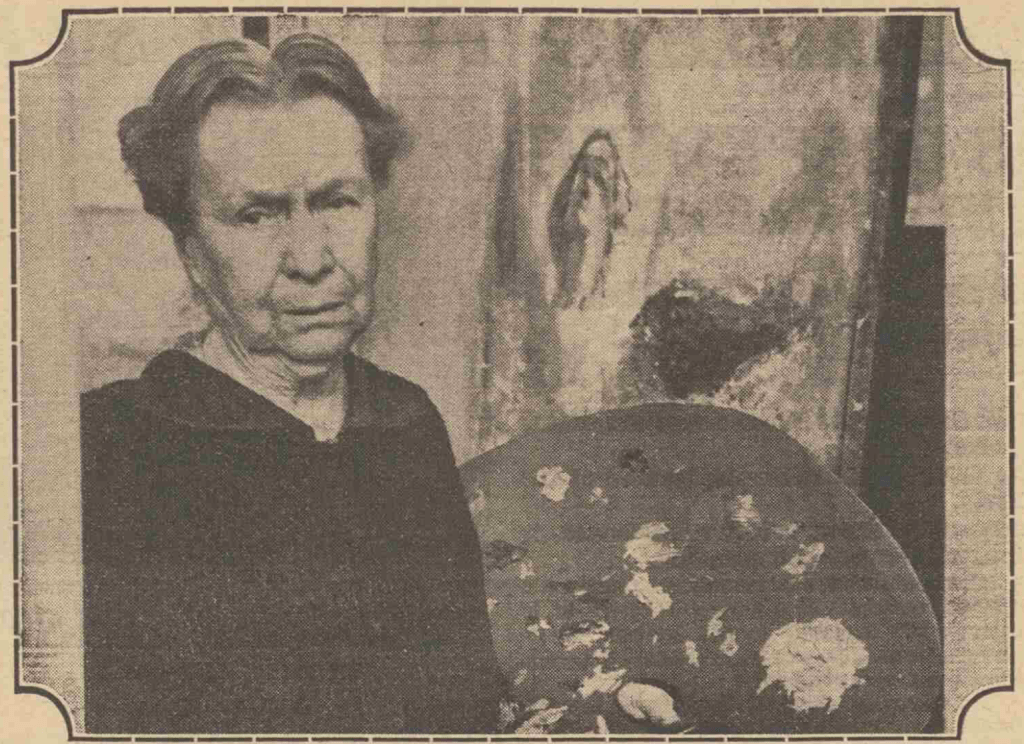
We regret to announce the death … of Mrs. Annie L. Swynnerton, the distinguished artist, which occurred at Hayling Island, Hants … Annie Louisa Swynnerton was born in Manchester, the third of seven daughters … She derived her education chiefly from the use she made of her father’s splendid library, where she acquired a passion for reading that always remained with her. (The Manchester Guardian, 25 Oct 1933, p4.)
… Even this year, after reaching her 87th birthday, Mrs Swynnerton was engaged in painting “An Image of Desire” and another picture, which were intended for the Academy.
Dame Laura Knight, noted for her pictures of circus life, who is now the only woman A.R.A., [1] paid tribute to Mrs Swynnerton yesterday.
“She was a great artist and a brave soul,” said Dame Laura. “Few people can understand what a fight it must have entailed for her to reach such perfection in her work, considering the difficulties she must have had in her early years, when it was by no means easy for any woman to study a subject seriously. I should like with profound respect and affectionate regard to pay this tribute to her memory – one of the greatest artists of her century and an original genius of the highest order.”
[1] Elected Associate 1927, full member 1936.
The Scotsman, 25 Oct 1933, p12.
Manchester Evening News, 25 Oct 1933, p4: “Recently she had written a number of letters, telling of her work, to Mrs. Bancroft, of the Manchester Academy of Fine Arts.”
The death is announced of Annie L. Swynnerton … She achieved success by her painstaking methods. When she wanted a background indicative of a particular season of the year she would work it as long as the season lasted, and then put it by for a year. One of her pictures occupied her for six successive Junes, and another required several Novembers for completion. Other paintings waited for years to enable her to secure an infrequent effect.
The Aukland Star, 25 Oct 1933, p7.
NOVEMBER
The Daily Gleaner, 3 November 1933:
Annie Swynnerton Dead in England … senior woman associate of the Royal Academy, whose “Dream of Italy” hangs in the Metropolitan Museum of Art, New York [incorrect, it hung in the Brooklyn Gallery], died [October 24] at the age of 88.
In spite of failing sight and other infirmities, the veteran artist continued painting until a few months ago … “The Unrelenting Past” in Ottowa is one of her best known works.
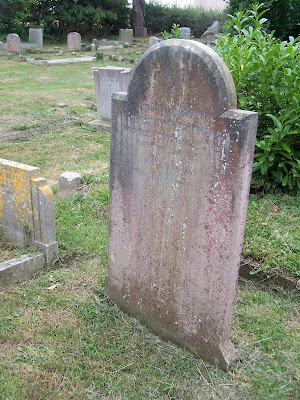
Annie’s grave, St. Mary’s Church, Hayling Island.
The inscription reads “I have known love and the light of the sun.”
(Source: Kirsty Stonell Walker at The Kissed Mouth blog.)
1934
JANUARY
£500 FOR ART / Mrs. Annie Swynnerton's gifts to Manchester / Mrs. Annie Louisa Swynnerton, A.R.A., of Chelsea, London ... left £8,982 gross, with net personalty £8,571 [c. £500,000 at 2023 value]. She left her pictures, "Montagne Mia" and "The Vagrant," and her husband's bas-relief, "Love Chalice," to the city of Manchester, and £500 [c. £29,000 at 2023 value] to the city of Manchester for the advancement of art in Manchester. [Manchester Evening News, 15 Jam 1834.]
ANNIE LOUISA SWYNNERTON, Deceased. Persuant to the Trustee Act, 1925, Section 27 (as ammended). / PERSONS having claims against the estate of Annie Louisa Swynnerton, deceased, late of 1A, The Avenue Studios, 76, Fulham Road, London, S.W., and also of Sicilia, Hayling Island, Hants, a Widow, A.R.A. (who died at Sicilia, Hayling Island aforesaid, on the 24th day of October, 1933, and whose Will was proved in the Principal Probate Registry on the 11rh day of January, 1934, by the National Bank Limited, the sole executor), are requested to send written particulars thereof to the undersigned before the 27th day of March, 1934, after which day the said executor will distribute the estate, having regard only to the claims then received. – Dated this 17th day of January, 1934. / STEPHENSON HARWOOD and TATHAM, 16, Old Broad Street, London, E.C.2., Solicitors for the said Executor.
FEBRUARY
Gloucestershire Echo, 1 Feb 1934:
WOMAN ARTIST’S 170 PICTURES
Sale Of He Palette Just As She Left It
Over 170 pictures by the late Mrs. Annie Swynnerton, A.R.A., from her studio in Fulham-road, are to be sold at Christie’s on February 9, along with a number of frames, easels, and her palette as she left it at her death.
… In the collection now to be sold there are 34 finished paintings, 136 unfinished (including some studies for her Academy exhibits), and a number of works by other painters.
… Her largest picture, “An Angel of Mercy,” measuring about 13 feet by 9 feet, is also among the unfinished works and there is another entitled “The Charmer,” painted on a 10 feet by 7 feet canvas.
… There are many Italian studies in the collection, and among the painter’s little treasures are many pieces of 17th century foience of which she was very fond.
Finally there is a panel of 16th century Flemish tapestry, some Persian rugs, a white marble bust of a Cardinal, and a little bronze figure of a woman, inscribed “Winifred” by the artist herself.
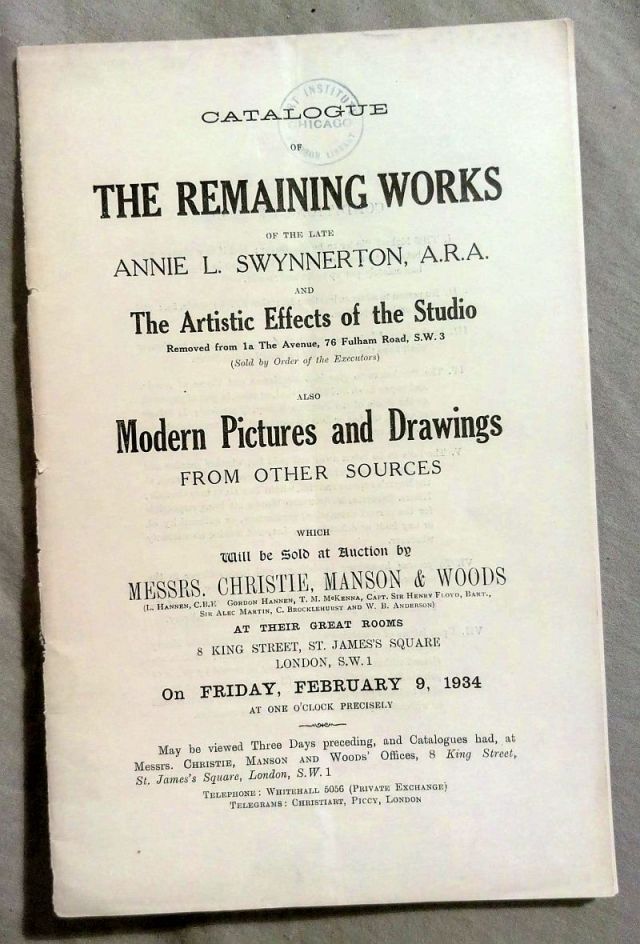
The Yorkshire Post, 10 February 1934:
DEAD WOMAN A.R.A.
£600 for Pictures of Mrs. Swynnerton.
From our London Correspondent
FLEET STREET, Friday.
When Mrs. Annie Swynnerton A.R.A., died, she left in her studio about 170 pictures, mainly rough and unfinished sketches abd these were sold at Christie’s today [Friday 9th]. Only about a score of them were finished and framed paintings; the remained being in a crude state on loose, unstretched canvas.
One portrait of Mrs. Charles Hunter that had been exhibited in Doncaster fetched the highest price, 85gns [£89 and 5 shillings, or £4,900 at 2022 value]; while a seascape shown at the Royal Academy drew 55gns [£57 and 15 shillings, or £3,310 at 2022 value].; and a small portrait of Henry James, the novelist, 18gns [£1,040 at 2022 value].
For the rough sketches there was very tame bidding, and the larger they were the lower the price. Three lots, including a 10ft. by 7ft. canvas, brought no more than one guinea [£69 at 2022 value].
The total realised for the collection was £601 [£33,200 at 2022 value].
1935
ROYAL ACADEMY / The Late Mrs. Swvnnerton‘s Election in 1922 / Sir,— For a number of years past statements have appeared the Press, in spite of repeated contradiction, that Dame Laura Knight is the first woman to made Associate the Royal Academy In modern times. In a well-known Sunday paper of November 17 last the following mis-statement of fact appears: “Dame Laura (Knight) is the only woman to elected Associate the Royal Academy since it was founded in 1768.” As this great injustice to a world-famous artist — the late Mrs Annie L. Swynnerton, A.R.A., who, incidentally, was my aunt — would you please allow to give the facts? Dame Laura Knight is neither the first woman to elected to the Academy nor even the first to elected in recent years. Further, she is not the only woman who at the present time holds this distinction. When the Academy was founded In 1788. two well-known women artists were made members — Angelica Kaufmann and Mary Moser. Then for 154 years the Royal Academy deliberately refused elect any woman artist, no matter how distinguished: but finally, in 1922, Mrs. Annie L. Swynnerton was elected A.R.A. Dame Laura Knight did not become a member of the Academy until 1927. while Mrs. Procter was elected 1934. This can, of course, be verified by communicating with the Royal Academy, Burlington House, London, W.l. — Yours, etc., DAVID BROWNLIE, 44, Grange Road, Ealing. W.5. Nov. 26.
1936
The Guardian, 21 February 1936:
“The Art Gallery Committee has been considering how best to use a bequest of £500 [£27,600 at 2022 value], left to Manchester by Mrs. Annie L. Swynnerton, “for the advancement of art.” … Mrs. Swynnerton can be claimed as a Manchester painter …”
1937
Dunee Evening Telegraph, 16 July 1937:
“Manchester Art Gallery Committee decided to offer a £125 [£6,560 at 2022 value] scholarship out of a bequest by the late Mrs. A. L. Swynnerton, a Manchester artist, to enable a Manchester artist to study for a year in London, Paris, or elsewhere.”
"Scholarship will take her to Paris / After fashioning figures in clay at a little studio at her home in Altrincham for six months, 21-year-old Miss Marcia D. H. Reynolds has been awarded a grant under the Swynnerton Bequest from the Manchester Art Gallery Committee to continue her studies in sculpture in London and Paris." [Manchester Evening News, 25 Oct 1937, p1; Marcia Reynolds is recorded in the Glasgow Mapping Sculpture database as exhibiting in Manchester in 1938 and 1939.]
< 1920s
Page last updated 20 Nov 2025.
 ANNIE LOUISA SWYNNERTON and SUSAN ISABEL DACRE (1844-1933)